For over a decade, shale has been a story of speed, scale, and repetition. Drill faster. Pump more. Repeat what worked next door.
But as the industry matures, the cracks in that playbook are becoming harder to ignore.
At Computer Modelling Group, through our work with operators globally, one theme is consistent: the winners in shale are no longer those who do more, but those who understand more.
This edition of Accelerate brings together seven unconventional rules emerging from the field that point toward a more deliberate, simulation-driven future.
1. Don’t Assume the Rock is the Same Next Door
Shale development suffered from a costly habit: copying designs from nearby wells.
But subsurface variability doesn’t respect lease lines. Even small geological differences can dramatically alter outcomes, leading to ineffective fracture stages, missed production targets, or worse, frac hits that permanently damage wells.
What’s changing: Operators are moving away from assumption-driven design toward reservoir-specific modeling, using simulation to predict fracture behavior, interactions, and risks before execution.
The shift: From copying neighbors → to understanding your own rock.
2. Design Pads, Not Wells
The era of optimizing single wells in isolation is over.
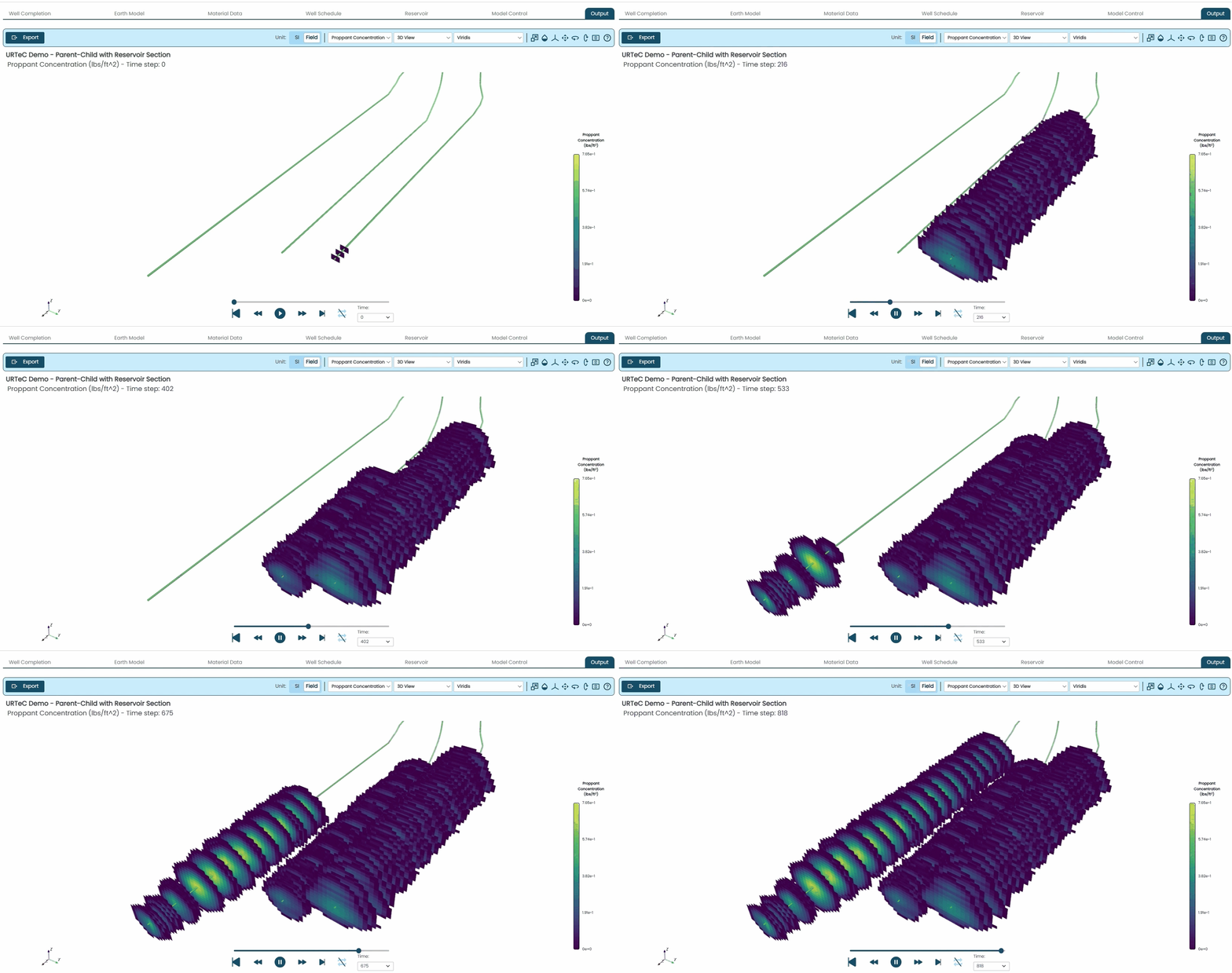
Tighter spacing and cube development have shown that maximizing one well can easily cannibalize another. In some cases, aggressive pad designs have resulted in significant EUR degradation across wells.
What’s changing: Leading teams now treat the pad as the unit of optimization, using simulation to evaluate well spacing, sequencing, and interference across entire developments.
The shift: From single-well thinking → to system-level design.
3. Time Your Refracs Before the Window Closes
Refracturing offers a second chance at recovery, but only if timing is right.
Too early, and you waste capital. Too late, and the reservoir has already given up its value.
What’s changing: Operators are using simulation to identify the optimal refrac window, balancing pressure, remaining hydrocarbons, and future development plans.
The shift: From reactive refracs → to strategically timed interventions.
4. Give Your Wells Room to Breathe
The industry’s journey from wide spacing to aggressive downspacing has revealed a hard truth: more wells don’t always mean more value.
Child wells often underperform when placed too close to parent wells due to pressure depletion and interference.
What’s changing: Simulation is now being used to determine optimal spacing, balancing recovery with economics rather than chasing density alone.
The shift: From maximum density → to maximum value per acre.
5. Pump Smarter, Not Harder
Longer laterals. More sand. More stages.
For years, completions followed a “bigger is better” mindset. But escalating costs and diminishing returns are forcing a rethink.
What’s changing: Operators are adopting a design-of-experiments mindset, using simulation and diagnostics to tailor completions to reservoir response rather than industry trends.
The shift: From maximizing inputs → to optimizing outcomes.
6. Don’t Leave Oil Behind. Model EOR Before You Abandon
Most shale wells recover less than 10% of the oil in place. The rest remains stranded.
Unconventional EOR, once dismissed, is now gaining traction, with techniques like huff-and-puff showing promising uplift when applied early.
What’s changing: Simulation is helping operators evaluate EOR feasibility, timing, and design, turning what was once experimental into a repeatable strategy.
The shift: From one-and-done wells → to lifecycle optimization.
7. Unconventional Isn’t Just American Anymore
Shale is no longer a U.S.-only story.
From Argentina’s Vaca Muerta to emerging plays in the Middle East, China, India, and Australia, unconventional development is going global, often faster and more digitally enabled than its U.S. origins.
What’s changing: Global operators are leapfrogging the learning curve by embedding simulation and integrated planning from day one.
The shift: From regional expertise → to global, technology-driven execution.
The Common Thread: From Assumption to Simulation
Across all seven rules, one pattern stands out: The industry is moving away from experience-driven decisions toward predictive, simulation-driven workflows.
This isn’t just about better wells. It’s about:
- Reducing uncertainty
- Improving capital efficiency
- Unlocking more recovery from existing assets
- Scaling best practices globally
In a world where margins are tighter and expectations are higher, guesswork is no longer a viable strategy.
Final Thought
Shale’s first chapter was about proving what was possible. The next chapter is about proving what is optimal.
And increasingly, that answer isn’t found in the field alone. It’s found in the digital reservoir first.
At CMG, we’re helping operators put these principles into practice: using simulation to plan better, optimize faster, and recover more.
Learn how with ShaleSim → https://www.cmgl.ca/solutions/software/shalesim/