
All major releases, enhancements, and what they mean for your simulations.
Webinar Events – Eastern Hemisphere: 24 Feb | 09:00 UTC | Western Hemisphere: 26 Feb | 16:00 UTC

We are innovators combining science and technology with deep industry expertise to solve complex subsurface and surface challenges. Learn more about the technology behind the our solutions.
CMG has a rich history of bringing industry-first solutions to the market. Our expertise encompasses a broad spectrum of energy workflows and our technology can help energy companies navigate this complex landscape.
Our CMG 4.0 Strategy, announced in 2022, is a multi-faceted transformation strategy focused on growth, profitability, and acquisitions.
Stock quotes are 15-minute delayed
We are a global software and consulting company that combines science and technology with deep industry expertise to solve complex subsurface and surface challenges for the new energy industry around the world.
We’ve created a wealth of educational assets to advance your industry and technical capabilities.

View Available Training Courses
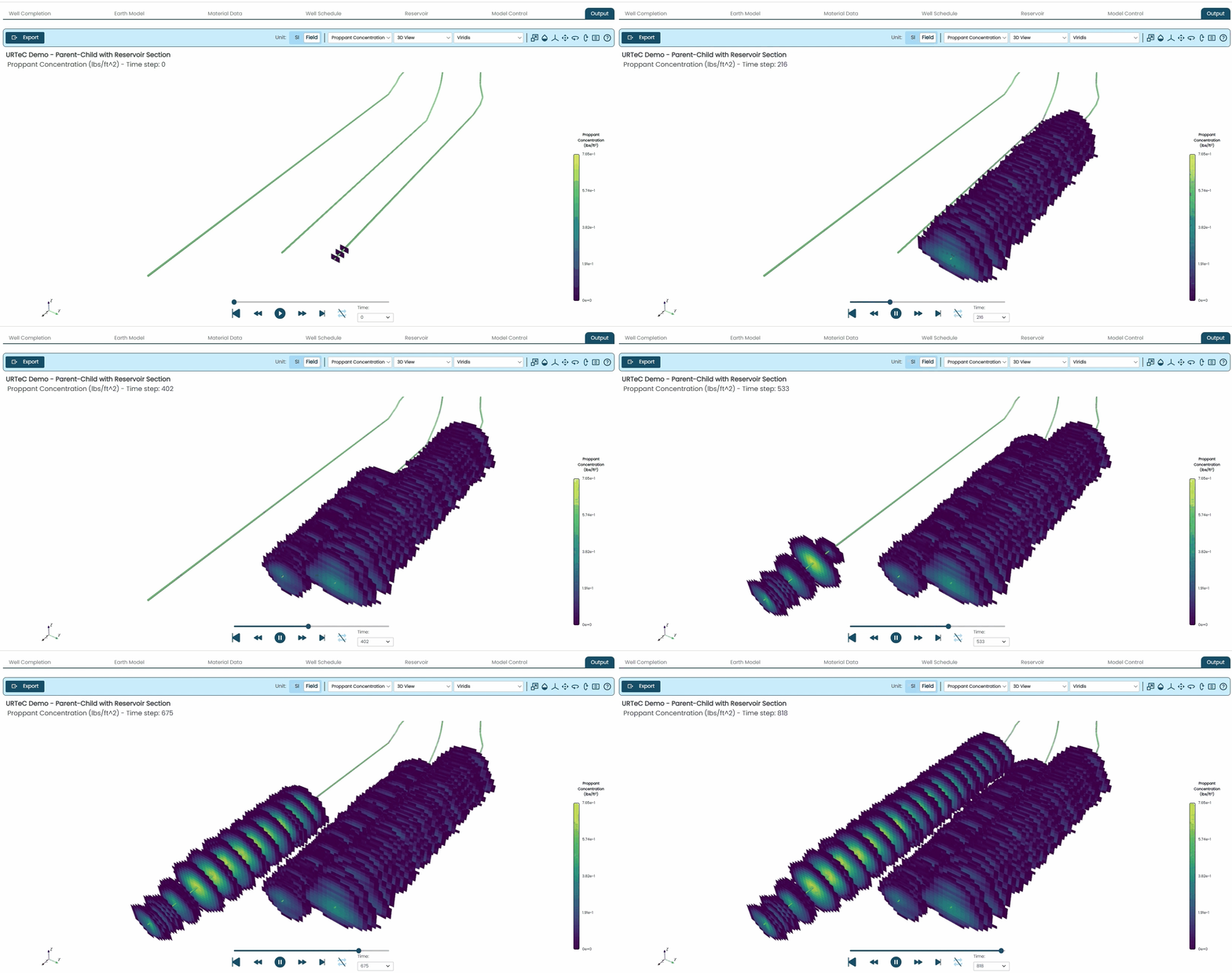
Hydraulic fracturing in unconventional reservoirs with closely spaced horizontal wells often results in complex interactions between existing (“parent”) wells and newly drilled (“child”) wells. These interactions, commonly referred to as frac-hits, are driven by depletion-induced stress changes around the parent well, which can alter fracture propagation, impact well performance, and reduce overall recovery efficiency.
This study presents an integrated modeling workflow that couples three-dimensional hydraulic fracture simulation, reservoir flow modeling, and geomechanical stress evolution, with calibration using Sealed Wellbore Pressure Monitoring (SWPM). The workflow captures the full lifecycle of parent-child well interactions, including depletion-driven stress redistribution, fracture propagation, and inter-well communication.
The methodology is applied to a field case in the Eagle Ford Formation, where production from the parent well creates localized pressure depletion and stress anisotropy. These conditions lead to preferential fracture growth from the child well toward the depleted region. By integrating SWPM diagnostics, the model is calibrated against observed pressure responses, enabling quantitative estimation of fracture half-length, height containment, and cluster efficiency.
Results show strong agreement between field measurements and simulation outputs. SWPM-derived Volume to First Response (VFR) data provides a direct link between injected fluid volume and fracture propagation, allowing validation of fracture geometry and growth behavior across both lateral and vertically stacked wells.
Why This Matters
This study demonstrates how integrating physics-based simulation with field diagnostics can significantly improve understanding of fracture-driven interactions in unconventional reservoirs.
The workflow provides a quantitative, field-calibrated framework for:
SPE Paper#: SPE-230648
Year: 2026
Software: ShaleSim
Presented at the SPE Hydraulic Fracturing Technology Conference and Exhibition (2026)
Access the Full Paper
Read the full paper on OnePetro.