We are innovators combining science and technology with deep industry expertise to solve complex subsurface and surface challenges. Learn more about the technology behind our solutions.
CMG has a rich history of bringing industry-first solutions to the market. Our expertise encompasses a broad spectrum of energy workflows and our technology can help energy companies navigate this complex landscape.
We are a global software and consulting company that combines science and technology with deep industry expertise to solve complex subsurface and surface challenges for the new energy industry around the world.
Modeling Iodine Production Using Coupled Geochemistry in CMG GEM
Iodine production from subsurface brine reservoirs is governed by a complex interplay of fluid flow, gas solubility, and geochemical reactions.
Using CMG’s GEM simulator, a fully integrated workflow was developed to:
Model iodine production from brine systems
Capture gas dissolution effects (CH₄, CO₂)
Simulate mineral reactions controlling iodine release
Evaluate water injection and recycling strategies
Result: A predictive framework that enables operators to optimize iodine recovery, reduce uncertainty, and better manage reinjection strategies.
Why Iodine Modeling Matters
Iodine is a strategic resource used in:
Pharmaceuticals and medical imaging
Electronics and advanced materials such as Perovskite solar cells
Energy storage technologies
Unlike hydrocarbons, iodine is:
Dissolved in formation water (brine)
Produced indirectly through fluid movement and chemical reactions
This makes iodine production highly sensitive to:
Reservoir flow patterns
Water recycling strategies
Subsurface geochemistry
Operational Context
In typical iodine-producing reservoirs:
Natural gas and iodine are co-produced with water
Gas is separated at surface
Produced water is fully reinjected
Key implication: The reservoir behaves as a circulating reactive system, not a depletion-driven system.
The Challenge
Conventional simulation approaches:
Track pressure and flow
Ignore chemical reactions and aqueous processes
As a result, they cannot:
Predict iodine concentration changes
Capture mineral-driven iodine release
Evaluate long-term recycling effects
Solution: CMG GEM Coupled Workflow
CMG GEM enables a fully integrated modeling approach, combining:
1. Fluid Flow
Multiphase flow in porous media
Injector-producer interaction
2. Gas Solubility
Methane and CO₂ dissolution into brine
Modeled using Henry’s Law, accounting for:
Pressure
Temperature
Salinity
3. Geochemistry
Aqueous reactions (e.g., iodide transport)
Mineral reactions:
NaI dissolution → iodine release
Precipitation under changing conditions
4. Geomechanics (Optional but Enabled)
Pressure-induced deformation
Subsidence and stress effects
Model Overview
Reservoir Description
Fluid & Chemistry
Operational Strategy Modeled
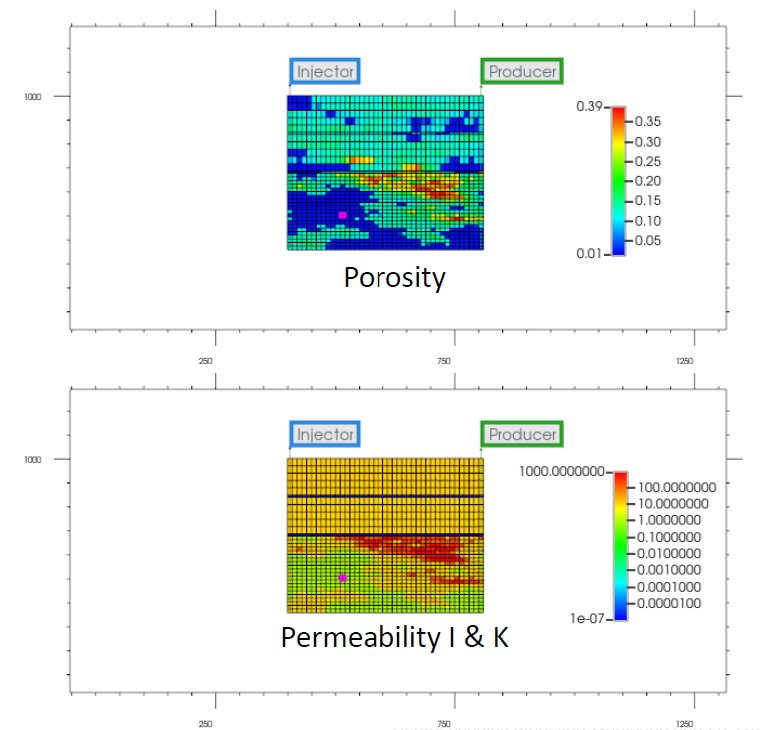
2D cross-sectional model
Water-saturated system (~100%)
Water Injection: 100 m³/day
Depth: ~1000 m
Methane-dominated gas phase
Water Production: 100 m³/day
Thickness: ~160 m
Iodine present as iodide (I⁻) in brine
Voidage Replacement Ratio = 1
Layered system (Kv/Kh = 0.1)
100% water recycling
This creates a dynamic circulation system, where injected water continuously alters reservoir chemistry.
Key Results
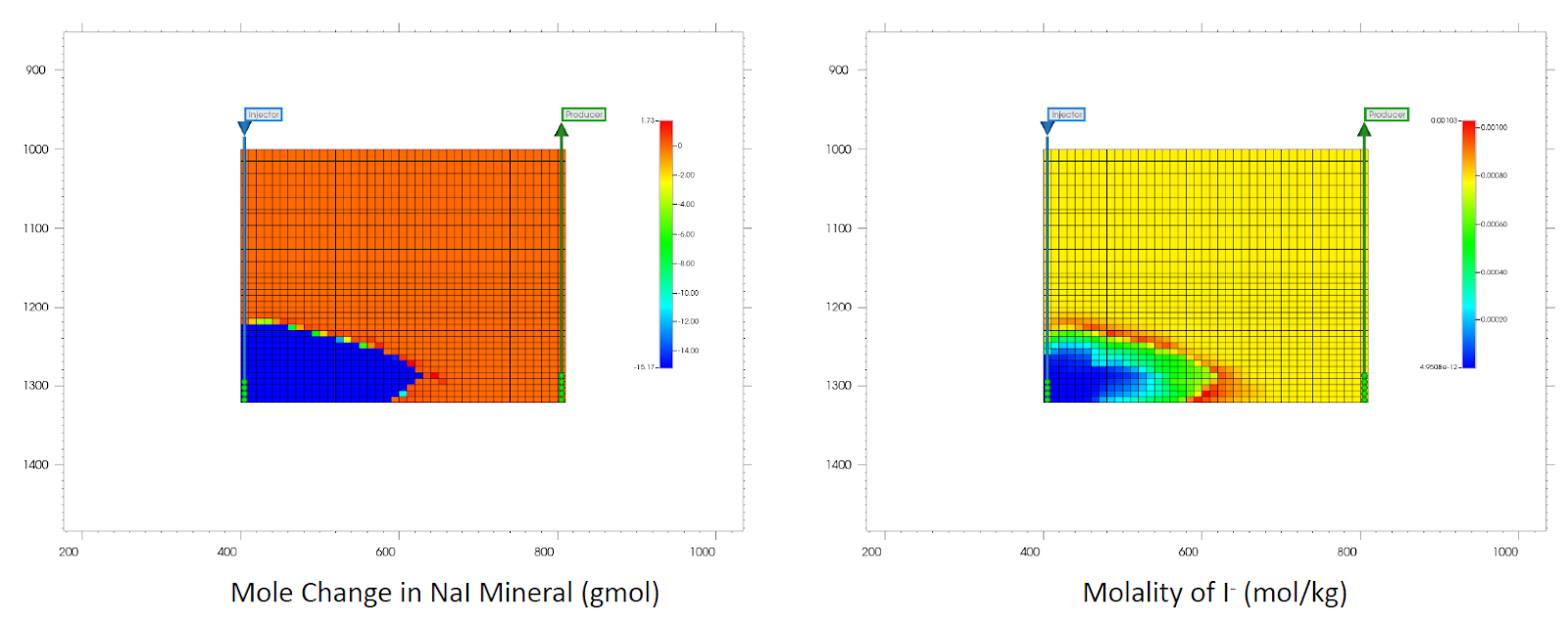
1. Iodine Mobilization Driven by Reactive Transport As shown in Figure 1, NaI dissolution is concentrated along injector–producer flow paths, indicating that iodine release is directly controlled by sweep efficiency and flow connectivity.
Figure 1: 5-Year Production Simulation Results Showing NaI Dissolution
Insight: Iodine production depends on
Flow pathways
Mineral dissolution dynamics
2. Injection Alters Reservoir Chemistry
Injected water:
Dilutes iodine concentration
Triggers additional mineral reactions
Insight: Recycling creates both production support and dilution effects
3. Pressure & Mechanical Effects
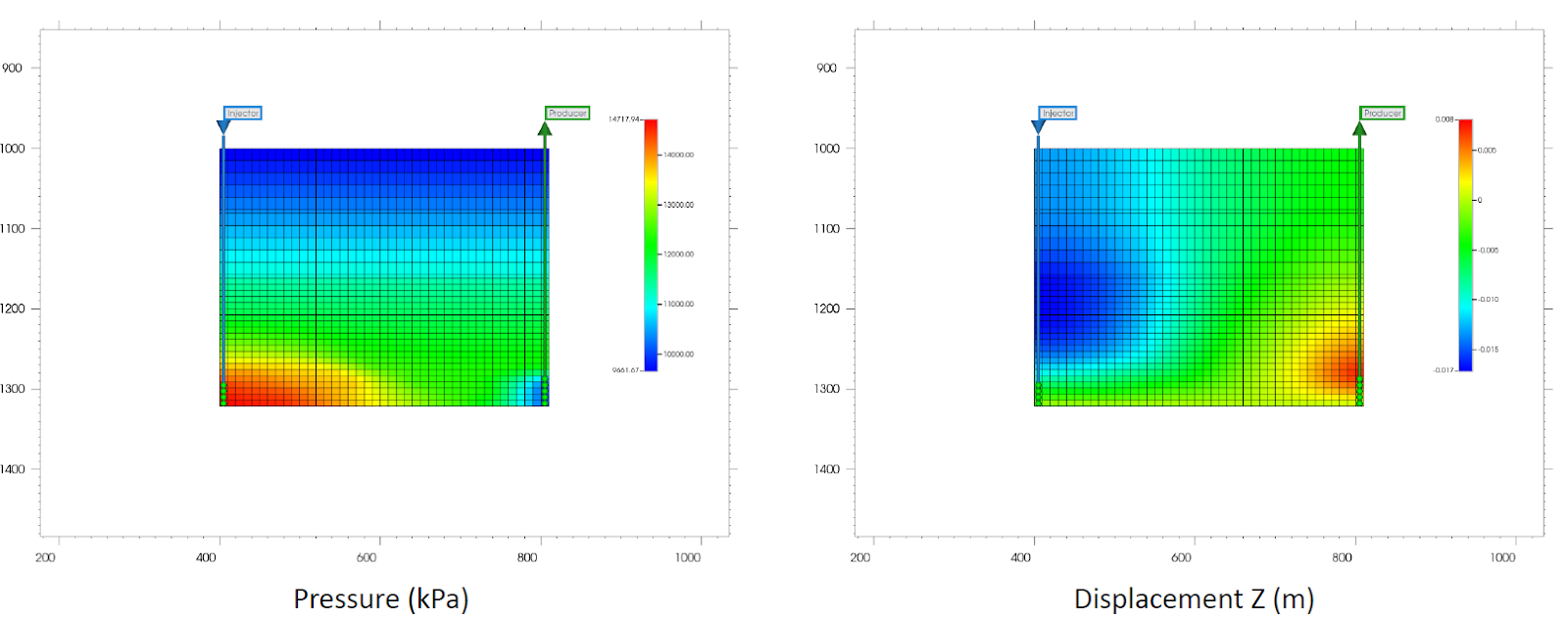
As shown in Figure 2, strong pressure gradients develop between the injector and the producer, driving flow and inducing measurable vertical displacement. It highlights the coupled impact of injection on both fluid movement and reservoir deformation.
Insight: Long-term operations can impact
Reservoir structure
Flow pathways
Figure 2: 5-Year Production Simulation Results Showing Pressure Gradients
4. Long-Term Production Behavior
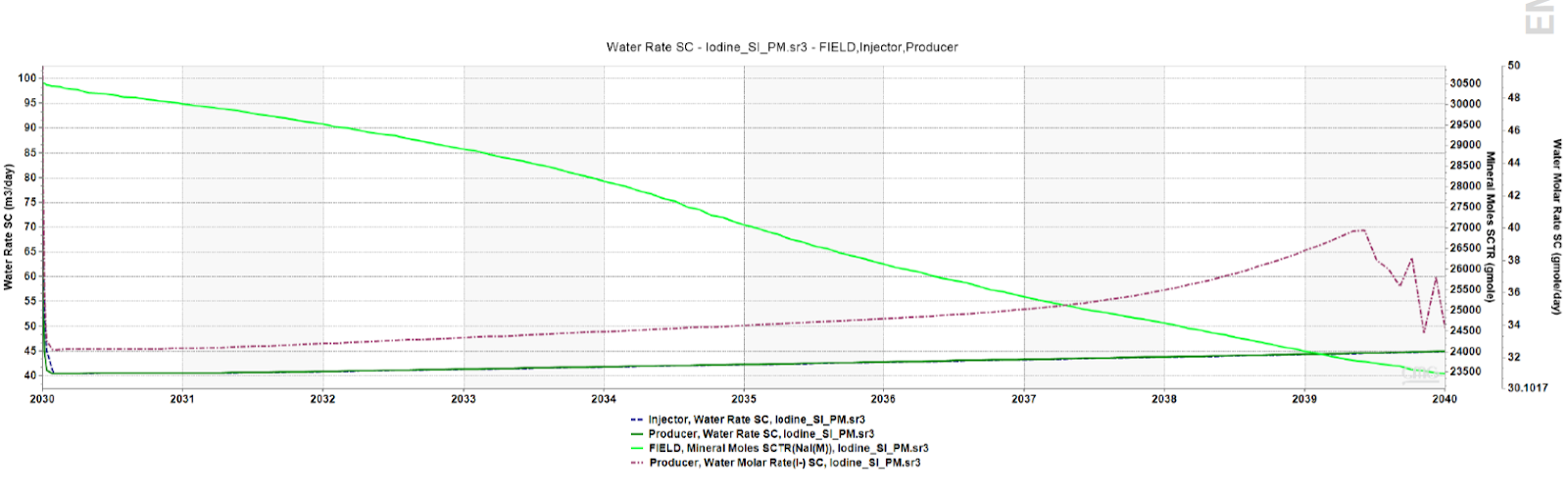
Short-term: Stable iodine production
Mid-term: Decline due to dilution
Long-term: Complex behavior from recycling and redistribution
Insight: Figure 3 shows a non-linear iodine production profile, where early-time stability is followed by dilution-driven decline and late-time redistribution effects, demonstrating the impact of continuous water recycling on iodine concentration.
Figure 3: Illustrates Long-term Production Behavior
Key Takeaways
Iodine production is geochemistry-driven, not purely flow-driven
Mineral buffering (NaI) plays a critical role in sustaining production
Water recycling introduces both benefits and risks:
Sustains reservoir pressure
Alters chemistry and concentration
Gas solubility influences aqueous chemistry, impacting iodine availability
Best Practices
Incorporate geochemistry when modeling dissolved resources
Use Henry’s Law-based solubility models for gas–water systems
Explicitly model:
Mineral phases
Aqueous reactions
Treat water injection systems as closed-loop reactive systems
Conclusion
This study demonstrates that:
Accurate iodine production forecasting requires coupling flow, geochemistry, and operational strategy.
CMG GEM provides a unified platform to model this complexity, enabling operators to design injection strategies that directly control iodine recovery rather than reacting to uncertain production behavior.