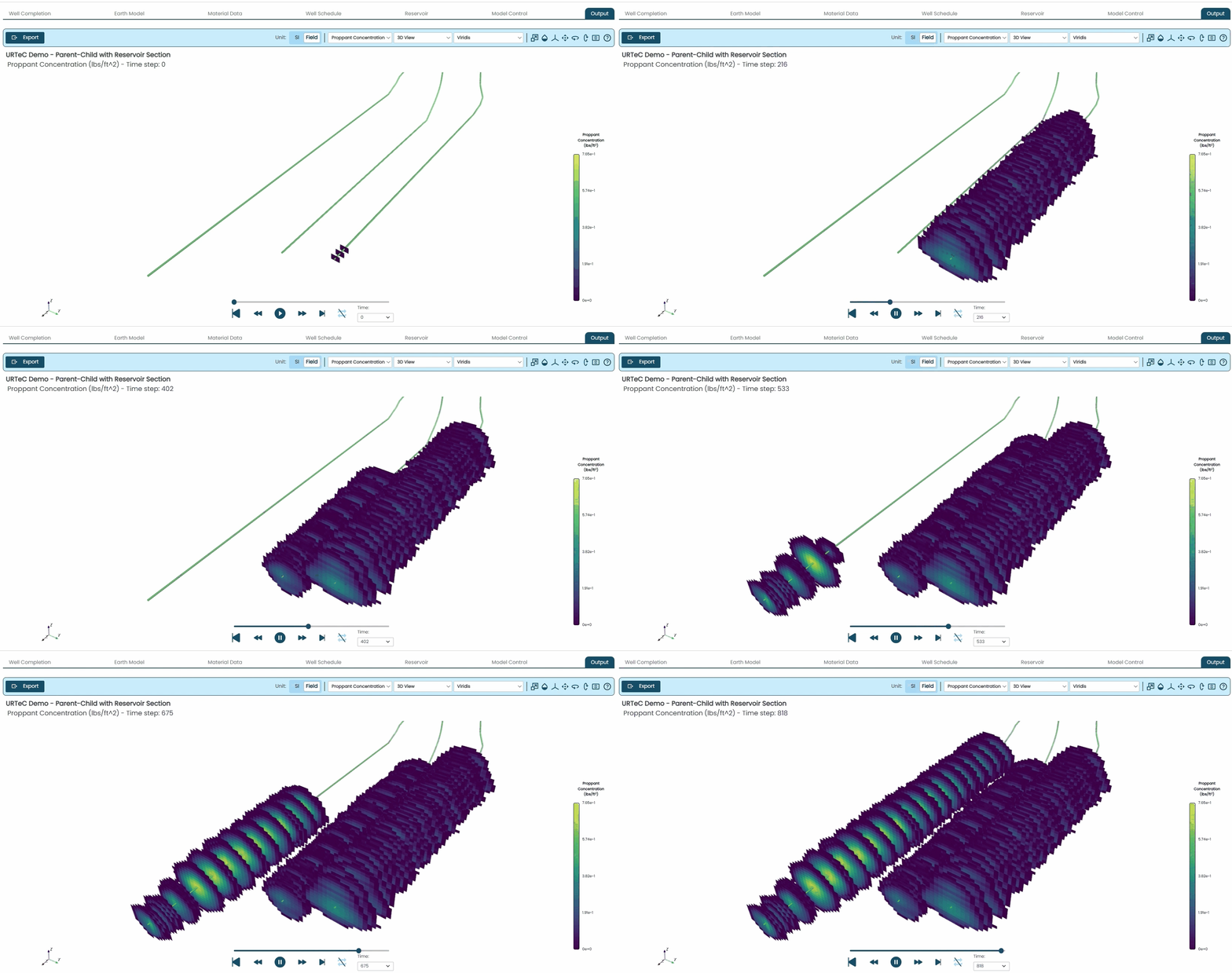

CMG Product Yearbook 2025 -

 All major releases, enhancements, and what they mean for your simulations.

Webinar Events – Eastern Hemisphere: 24 Feb | 09:00 UTC | Western Hemisphere: 26 Feb | 16:00 UTC

Stars.svg
Case Studies

Modelling Thermosyphon-Driven Heat Recovery in Enhanced Geothermal Systems with CMG STARS

Stars.svg

Enhanced geothermal systems can deliver continuous, low-carbon energy, but their performance depends on how fluid moves through the system, not just how hot the rock is.

In this study, CMG STARS was used to model a superhot dry rock EGS system with parallel horizontal injector and producer wells connected by hydraulic fractures. 

The results show that injection rate is one of the most important design and operating levers in EGS. At lower injection rates, thermosyphon behavior can sustain flow without pumping. At higher rates, the system enters two-phase conditions earlier, increasing flow complexity and accelerating thermal decline.

Outcome: CMG STARS provided a physics-based framework to evaluate long-term heat recovery, identify operating limits, and support more realistic geothermal development decisions.

Why EGS Modelling Matters

Unlike conventional hydrothermal systems, EGS depends on engineered connectivity between wells and hot rock. That means project performance is controlled by coupled subsurface physics rather than by reservoir temperature alone.

In geothermal systems, critical processes include:

  • fluid flow in porous and fractured media 
  • conduction, convection, and dispersion 
  • wellbore heat loss and hydraulics 
  • hydraulic fracture behavior 
  • fluid phase behavior 
  • geomechanics and geochemistry where relevant 

Because these mechanisms interact over time, simplified models can miss the conditions that determine whether a system performs efficiently, enters two-phase flow early, or requires external pumping.

What Is Thermosyphon Flow in EGS?

Thermosyphon flow is the natural circulation of fluid driven by temperature-induced density differences, without requiring an external pump.

In this EGS setup, the effect emerges when injected fluid heats up as it moves through the system. Under the right conditions, this density contrast supports flow from injector to producer with minimal mechanical assistance. 

That makes thermosyphon behavior highly relevant for geothermal project economics and operating strategy.

The Challenge

The key question in this case was not simply whether heat could be extracted.

It was: Under what operating conditions can an EGS system deliver sustainable heat recovery while preserving favorable flow behavior over time?

To answer that, the model needed to capture:

  • pressure loss from injector through fractures to producer 
  • fluid heating along the injector, fractures, and producer 
  • steam generation and movement of the two-phase region 
  • the effect of injection rate on bottomhole and wellhead conditions 
  • the presence or loss of thermosyphon support 

Solution: Full-Physics EGS Simulation in CMG STARS

CMG STARS was used to simulate the EGS system as an integrated thermal-flow problem rather than as an isolated wellbore or simplified heat-transfer model.

The workflow captured:

1. Reservoir and Fracture Heat Transfer
Heat moves from superhot dry rock into the injected fluid through both conduction and convection.

2. Transient Wellbore Behavior
Using FlexWell, the model accounted for pressure drop, temperature evolution, and flow behavior along the wellbore. 

3. Water Phase Behavior
As fluid heats along the flow path, it can transition into two-phase conditions and ultimately produce supersaturated steam near the producer.

4. Thermosyphon Effects
At lower injection rates, density differences create natural circulation that can reduce or eliminate the need for pumping. 

Operational Context: Model Overview

The simulated EGS configuration included:

  • parallel horizontal injector and producer wells 
  • well depth of 15,000 ft 
  • lateral length of 8,000 ft 
  • well spacing of 1,500 ft 
  • hydraulic fractures connecting injector and producer 
  • fracture conductivity of 60 md·ft 
  • fracture height of 400 ft 
  • working fluid: water 
  • reservoir temperature: 815°F (435°C) base case 
  • injection temperature: 75°F 
  • supercritical geothermal conditions in the reservoir 

Sensitivity analysis was performed on:

  • injection rate: 13, 28, 47, and 83 kg/s 
  • producer wellhead pressure: 1000 psi and 150 psi 

Key Results
1. Base-Case Performance Shows Strong Initial Heat Recovery
In the base case at 13 kg/s, the producer well maintained:

  • 100% steam quality 
  • a producer WHP constraint of 1000 psi 
  • energy output of roughly 38.5 MW initially, declining to about 36.11 MW before sharper decline later in the forecast 

After about 18 years, enthalpy and energy output declined more sharply as cooling developed around the fractures and reduced fluid heating. 

Insight:
A geothermal system can show strong early performance while still being vulnerable to long-term thermal depletion near the fracture network.

2. Lower Injection Rates Favor Thermosyphon Behavior
At lower injection rates:

  • the injector well was not fully filled with fluid 
  • the upper part of the injector remained under vacuum 
  • injector BHP was lower than the equivalent full liquid head over 15,000 ft depth 

Insight:
This enables operators to define maximum injection rates that preserve pump-free operation and avoid unnecessary energy consumption.

3. Higher Injection Rates Push the System into Two-Phase Conditions Earlier
As injected water moves through the fractures, it heats up and enters a two-phase region before becoming supersaturated steam closer to the producer. 

The simulations showed that:

  • the two-phase region advances toward the producer over time 
  • higher injection rates cause that two-phase region to reach the producer sooner 

Insight:
This introduces a system-level trade-off: higher injection rates may increase short-term thermal power output, but can reduce overall efficiency and increase surface facility costs due to two-phase flow handling requirements..

4. Thermosyphon Effect Sustains Vacuum Injection and High Producer Wellhead Pressure
The producer well remained at 100% steam quality throughout the wellbore in the base case, but wellbore hydraulics still mattered.

For the base case, the study showed that:

  • pressure at the producer wellhead remained around 1000 psi 
  • smaller producer well diameter increases pressure drop 
  • the injector remained under vacuum in the thermosyphon regime 

Insight:
Even with high thermal energy in the reservoir, wellbore pressure losses can limit surface deliverability, making well design a critical factor in realizing actual energy output.

5. Pressure-Enthalpy Analysis Defines the Operating Envelope
One of the key challenges in geothermal reservoir simulation is accurately capturing fluid phase behavior near the critical region, where small changes in pressure and temperature can lead to large changes in fluid properties.

As shown below, the system spans multiple thermodynamic regimes:

  • Injector: liquid phase 
  • Fractures: two-phase flow, approaching near-critical conditions 
  • Producer: supersaturated steam 

The trajectory passes close to the critical point, where numerical instability and inaccurate phase representation are common in many simulators.

CMG STARS accurately captures this full phase transition, from liquid to two-phase to superheated steam, across the entire system, including near-critical conditions.

To benefit from thermosyphon effect for up to 25 years without entering the two-phase region at the producer, injection rate must be 13 kg/s or lower, allowing pump-free operation.

Insight:
This is not just a modelling output. It is an operating guideline. It defines the upper limit for preserving a pump-free thermosyphon regime over long time horizons.

It also demonstrates the importance of using a simulator capable of accurately representing phase behavior across critical and near-critical conditions, as these transitions directly impact system performance and operating strategy.

Why This Matters for Geothermal Development

This study shows that EGS performance is not controlled by temperature alone, but by the interaction of heat transfer, flow dynamics, and phase behavior.

That means design choices cannot be made using heat-transfer intuition alone.

Operators need to know:

  • when pumping may be avoidable 
  • when higher rates reduce long-term efficiency 
  • how quickly two-phase conditions will develop 
  • how pressure constraints affect surface energy output 

Surface Facility Considerations and System-Level Trade-Offs

Enhanced geothermal system performance is not determined by subsurface behavior alone. Surface facilities, particularly turbines and separation systems, play a critical role in overall efficiency and project economics.

In thermosyphon-driven scenarios, the system produces dry or superheated steam that can be directly used in turbines, with higher efficiency and minimal processing requirements.

In contrast, higher injection and production rates often lead to two-phase flow (steam + liquid) at the surface. In these cases:

  • Steam must be separated from liquid before entering the turbine 
  • Separation systems introduce additional capital and operating costs 
  • Turbine efficiency is reduced compared to dry steam systems

Image Source: Wikipedia

As shown in the figure above, Dry steam systems (left) enable direct turbine operation with higher efficiency, while flash steam systems (right) require phase separation, increasing complexity and reducing overall system efficiency.

Key Takeaways

  • EGS performance is highly sensitive to injection rate. Lower-rate operation can preserve thermosyphon-assisted flow. Higher-rate operation can accelerate two-phase breakthrough near the producer 
  • Long-term energy output declines as cooling develops around fractures 
  • Wellbore pressure losses and producer constraints must be modeled alongside reservoir heat transfer 
  • Optimal EGS operation requires balancing subsurface performance with surface facility efficiency, including turbine performance and separation requirements
  • CMG STARS provides a practical way to evaluate these coupled effects in one framework 

Best Practices from This Study

  • Model geothermal systems as integrated reservoir–fracture–wellbore systems 
  • Evaluate injection rate not just for heat extraction, but for its effect on phase behavior and flow regime 
  • Use transient wellbore modelling is essential to accurately capture heat loss and pressure drop along the producer wellbore up to the surface
  • Evaluate operating strategies in the context of surface facility performance, including turbine efficiency and separation requirements
  • Align subsurface optimization with overall project economics, not just reservoir performance

Conclusion

This study demonstrates that successful EGS design depends not only on how much heat is available, but on how fluid flows, evolves, and interacts with the system over time.

Using CMG STARS, the team showed that thermosyphon-assisted geothermal recovery is achievable under specific operating conditions, but is highly sensitive to injection rate, fracture heating, and phase behavior. While lower-rate operation can sustain thermosyphon flow and produce dry steam, higher rates may increase short-term thermal output but introduce two-phase flow, additional surface processing requirements, and reduced system efficiency.

As a result, optimal EGS development requires balancing subsurface performance with surface facility efficiency, turbine performance, and overall project economics.

About This Resource

Paper#: NA

Year: 2026

Software: STARS

Rose Subsurface Assessment is now a part of Computer Modelling Group Ltd.