Why the next shale revolution won’t look like the first
For years, unconventional development was treated as a uniquely American story.
But something more interesting is happening now.
The rest of the world isn’t copying U.S. shale. It’s rebuilding it under very different constraints.
And that distinction matters.
The next unconventional boom will not look like Texas
Global unconventional is no longer theoretical.
Non-U.S. shale production is projected to reach 5–6 million boe/d by 2030, roughly comparable to what the Permian produces today.
But this growth isn’t uniform. It’s already splitting into two paths:
- Oil-led growth → Argentina
- Gas-led strategies → China, Middle East, Australia
That changes the question.
It’s no longer: Can shale work outside the U.S.? It’s:
Who can build a local operating model fast enough to make it repeatable?
If you want proof that unconventional can scale, start in Neuquén
If you want one country that has already broken the myth that unconventional only works in North America, start with Argentina.
Vaca Muerta is now producing close to ~450,000 barrels per day, with gas volumes rising and LNG ambitions taking shape.
But Argentina didn’t succeed because it copied Texas perfectly.
It worked because several systems finally aligned:
- Strong rock
- A maturing operator base
- Improving pipelines
- A clear export story
And even then, it hasn’t been frictionless.
Pipeline constraints. Equipment bottlenecks. Financing challenges.
Unconventional doesn’t scale because geology is good. It scales when geology, infrastructure, and markets move together.
Outside the U.S., unconventional is becoming a gas story
If Argentina is the loudest oil success story, the broader global trend is increasingly about gas.
- China scaling shale gas
- Saudi Arabia building Jafurah
- UAE pushing for gas self-sufficiency
- Australia positioning Beetaloo for domestic supply
Why gas?
Because outside the U.S., unconventional is often driven by national priorities:
- Energy security
- Power demand
- Import reduction
- LNG optionality
Gas solves immediate problems.
In many countries, gas is what makes unconventional investable in the first place.
Most global projects won’t fail because the molecules are missing
Here’s the uncomfortable truth:
Most international unconventional projects won’t fail because of poor geology.
They will fail because the development model arrives before the basin is ready.
- China → complex geology, water constraints
- Argentina → infrastructure bottlenecks
- Australia → pipeline and environmental challenges
- UAE → still proving repeatability
And one more challenge:
Many operators are trying to compress 10-15 years of U.S. learning into 3-5 years.
That’s expensive.
Every wrong spacing decision. Every suboptimal completion. Every poorly sequenced development.
It all compounds.
The real bottleneck outside the U.S. is not the resource. It’s execution maturity.
The global winners will simulate before they manufacture
This is where the conversation gets serious.
The countries moving fastest are already showing the shift:
- China using advanced geological modeling and precision fracturing
- Middle East operators optimizing large-scale developments
- Global teams trying to de-risk early pilots
Outside the U.S., there is less room for trial-and-error:
- Fewer wells
- Higher capital exposure
- Limited service ecosystems
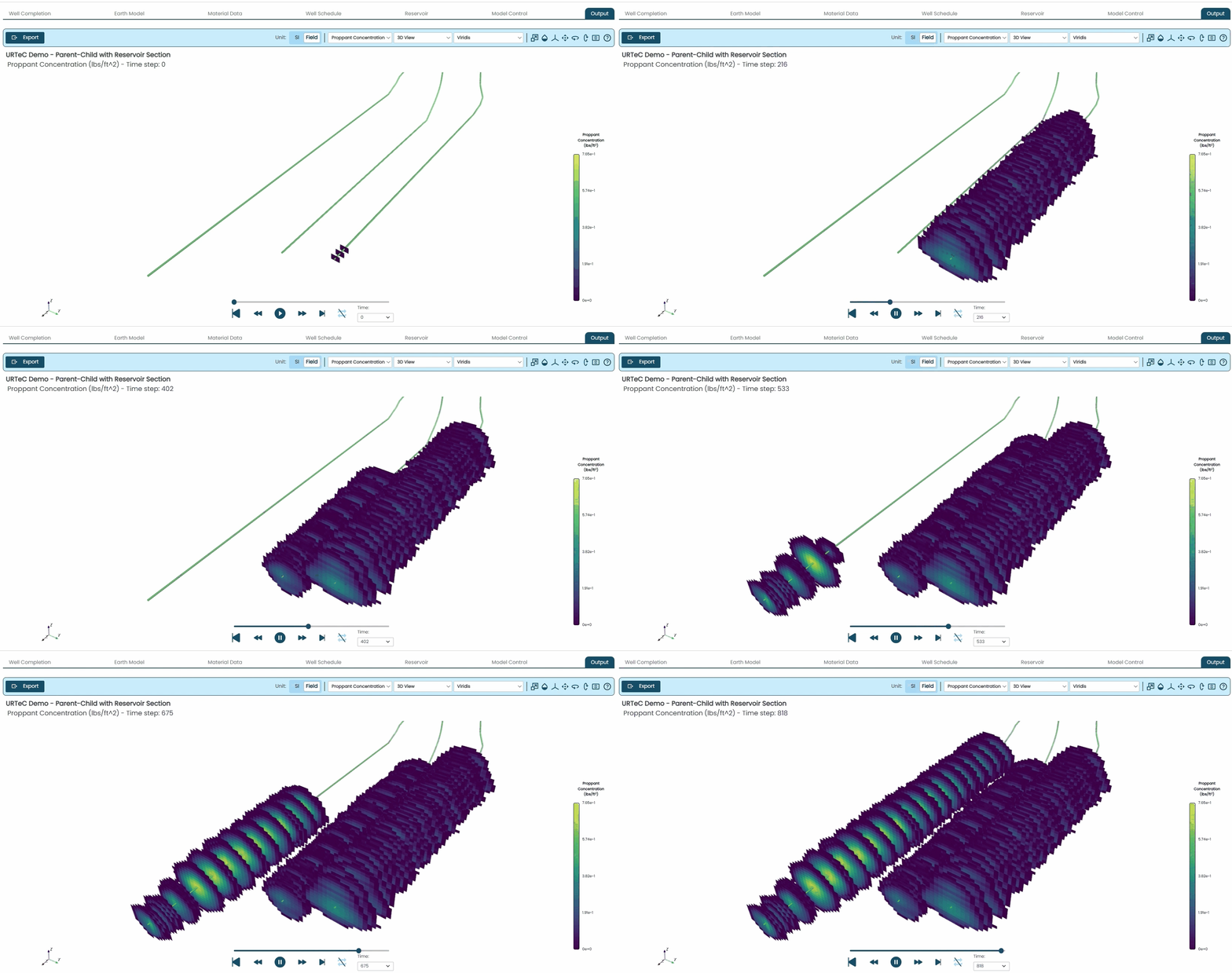
Which is why simulation is no longer optional.
It’s becoming core to execution.
What was “unconventional wisdom” is now global reality
- Don’t assume the rock is the same next door
- Design pads, not wells
- Time refracs carefully
- Give wells room to breathe
- Pump smarter, not harder
- Model EOR before you abandon
In the U.S., these are optimization principles.
Outside the U.S., they are survival rules.
Because mistakes don’t just impact one well. They can slow down an entire basin.
The real takeaway
The U.S. wrote the first chapter of unconventional.
But the next chapter will be written elsewhere.
Not by copying the playbook line by line. But by adapting it to local geology, infrastructure, and economics.
And the winners won’t be:
- The countries with the biggest resources
- Or the ones that move fastest
They will be the ones that:
Learn fastest without paying for every mistake in the field.
At CMG, we’re seeing this shift play out globally.
Operators are no longer asking: “What worked somewhere else?”
They’re asking: “What will work here, before we spend the capital?”
That’s exactly where simulation becomes critical.
Learn how CMG is helping operators apply these principles with ShaleSim: https://www.cmgl.ca/solutions/software/shalesim/