The Challenge: An operator needed to know whether a deep saline aquifer could sustain decades of commercial CO₂ injection before committing to major infrastructure.
With no production history, uncertain geology, complex faults, and variable injection compositions, the risk associated with injecting CO2 into the subsurface was considerable.
This project focused on several key questions:
- Can the reservoirs sustain commercial-scale injection rates?
- How sensitive is injectivity to geological uncertainty?
- How will plume migration interact with nearby faults?
- What impact do CO₂ impurities have on storage performance?
- How should wells be placed and managed over time?
- What surface conditions are needed for stable, year-round injection?
To answer these questions, CMG developed a compositional CCS reservoir simulation workflow incorporating geological uncertainty, dynamic well management, fault sensitivities, and operational forecasting.
Outcome
The project demonstrated that:
- Commercial-scale injection targets were only achievable in the higher-quality reservoir scenarios evaluated.
- Geological uncertainty was the largest driver of injectivity performance.
- Strategic well placement and phased multi-well development reduced fault interaction risk and helped meet injection targets.
- CO₂ impurity levels strongly affected injectivity and plume growth.
- Surface temperature changes significantly influenced required injection pressures.
Model Overview & Operational Context
CMG constructed a high-resolution compositional CCS reservoir simulation model using a geological grid of over 5 million cells. The model contained multiple faulted areas and different injection target zones.
The workflow was built to capture the full complexity of the system:
- Multiple geological realizations (P10, P50, P90) to incorporate uncertainty
- EOS-based compositional modelling in GEM for accurate CO₂ phase behavior
- Relative permeability hysteresis, solubility, and structural trapping mechanisms
- Fault leakage sensitivities via discrete fracture network (DFN) workflows
- Trigger-based dynamic well management with auto-drill logic
- Integrated wellbore and surface-network modelling via CoFlow
Operations were evaluated across multiple development phases: from pilot injection through full commercial-scale storage.
Key Results & Insights
Geological Quality Controlled Injectivity
Reservoir quality proved to be the single most important factor affecting storage performance.
Geological realizations with higher permeability and porosity consistently achieved the planned injection targets. Lower-quality realizations struggled to sustain rates even after modifying well placement and operational strategies.
Insight
Geological variability is the dominant driver of long-term CO₂ injectivity performance.
Multi-Well Strategies Improved Storage Performance
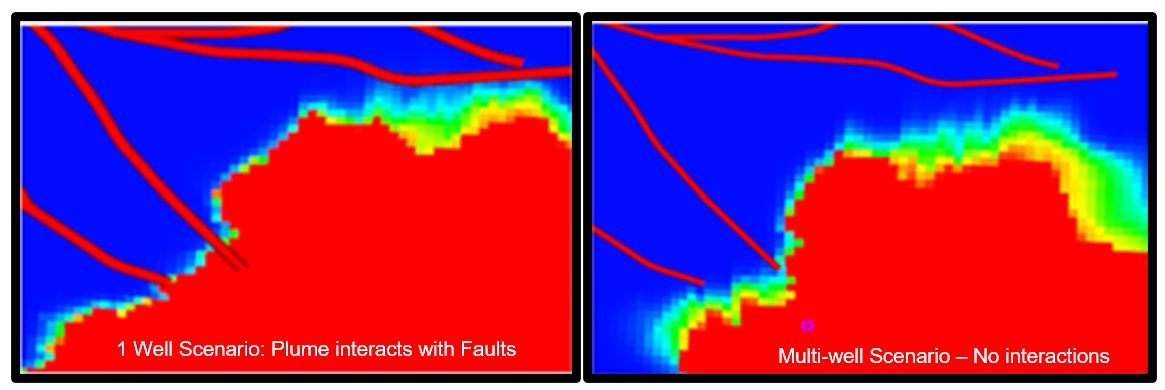
Single-well injection scenarios directed CO2 plumes toward faults. A dynamic well management framework was implemented including trigger-based monitoring, automatic injector shut-ins when plumes approached faults, sequential activation of secondary wells, and a drill queue. The result was a system that maintained storage targets while actively managing containment risk.
Insight
Well placement and phased injector management can be used to overcome uncertainty in reservoir quality in achieving long-term storage targets safely.
CO₂ Impurities Increased Plume Size and Reduced Injectivity
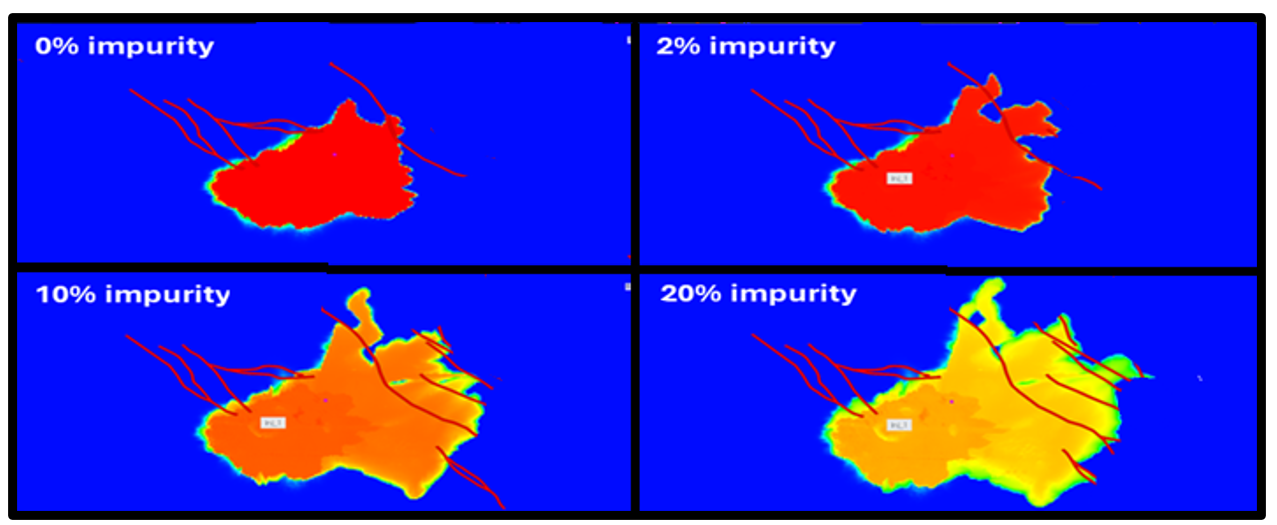
Higher impurity concentrations in the injection stream increased downhole fluid volume, raised bottomhole pressure, reduced injectivity, and expanded plume size. In most scenarios, impurity levels alone were enough to push the project outside its containment envelope. CO₂ composition is not just a surface processing question, it directly shapes what happens underground.
Insight
CO₂ stream composition directly influences injectivity, plume growth, and long-term containment risk.
Fault Interaction Risk Is Hard to See - Until It’s Too Late
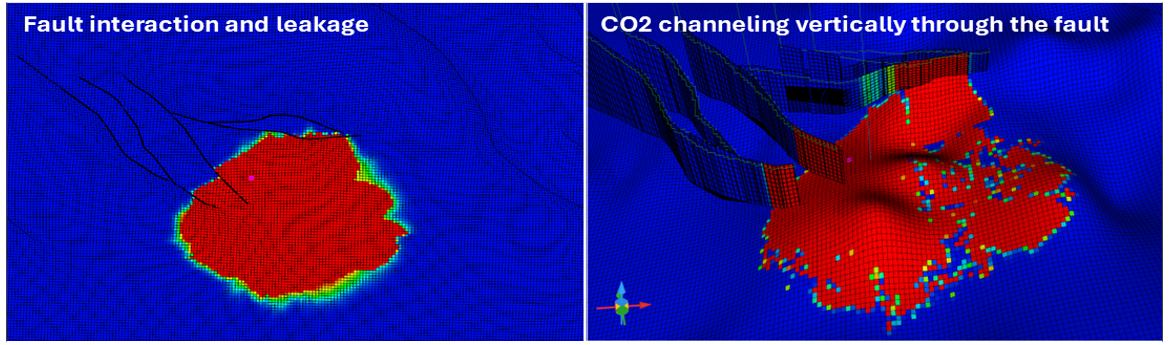
Fault transmissibility had a major impact on long-term containment forecasts. More importantly, the simulations showed that fault leakage can become significant without clear early warning signals from injector well pressure monitoring.. Mitigation planning cannot wait until leakage is observed.
Insight
Fault characterization is not optional in CCS. It belongs in the baseline risk model, not the contingency plan.
Surface Temperature Changes What You Can Inject
Coupling the reservoir model with wellbore and surface-network simulation via CoFlow revealed that seasonal temperature swings materially alter required surface injection pressures. CO₂ density is highly temperature-sensitive, and what works in January may not work in July. This finding directly informs compressor sizing and surface facility design - information that is invisible without integrated modelling.
The analysis may help define future operational requirements for surface equipment including compressors.
Insight
Surface temperature variations can materially affect injection pressure requirements, making integrated modelling essential for reliable year-round CCS operations.
Best Practices
- Evaluate Multiple Geological Realizations: Single deterministic models can significantly underestimate uncertainty in CCS performance.
- Couple Surface and Reservoir Models: Pressure and temperature losses along the injection system directly affect bottomhole injectivity.
- Test CO₂ Purity Scenarios: Impurity levels can materially affect injectivity, plume growth, and containment.
- Use Dynamic Well Management: Trigger-based workflows and phased well activation can improve both injectivity and containment performance.
- Include Fault Leakage Sensitivities: Understanding CO2 plume interaction with faults can help to quantify uncertainty surrounding containment.
Why CMG Matters
CMG’s integrated workflow allowed engineers to evaluate reservoir performance, wellbore behavior, and surface operating conditions within a single connected modelling environment.
The project combined:
- GEM compositional simulation
- CMOST uncertainty analysis
- CoFlow integrated modelling
- DFN-based workflows (Faults)
- Advanced dynamic operational controls
This allowed the team to move beyond isolated and deterministic reservoir forecasting and evaluate the complete CCS injection system from the surface facilities to long-term subsurface storage behavior under reservoir uncertainties.
As CCS projects become larger and operationally more complex, this level of integration becomes increasingly important for development planning and risk reduction.
Conclusion
Successful CCS depends on far more than storage volume. This project showed that injectivity, containment, and long-term performance are shaped by geology, well strategy, injection composition, fault behavior, and surface conditions.
CMG's integrated simulation framework gave the operator a clear, answer to the questions that matters most: Is this project viable? And on what terms?