ย All major releases, enhancements, and what they mean for your simulations.
Webinar Events – Eastern Hemisphere: 24 Feb | 09:00 UTC | Western Hemisphere: 26 Feb | 16:00 UTC

We are innovators combining science and technology with deep industry expertise to solve complex subsurface and surface challenges. Learn more about the technology behind our solutions.
CMG has a rich history of bringing industry-first solutions to the market. Our expertise encompasses a broad spectrum of energy workflows and our technology can help energy companies navigate this complex landscape.ย
Our CMG 4.0 Strategy, announced in 2022, is a multi-faceted transformation strategy focused on growth, profitability, and acquisitions.
Stock quotes are 15-minute delayed
We are a global software and consulting company that combines science and technology with deep industry expertise to solve complex subsurface and surface challenges for the new energy industry around the world.
We’ve created a wealth of educational assets to advance your industry and technical capabilities.

View Available Training Courses
Reservoir simulation is computationally intensive, often solving millions of equations to model complex physics (e.g., multiphase flow, thermodynamics, geomechanics, etc). In the past, simulators ran on single CPUs and were limited by sequential processing speed. But today, the simulators leverageย parallelismย at multiple levels:
However, one often overlooked aspect isย I/O and data handling. HPC improvements also involve faster reading/writing of large datasets and smarter compression to reduce communication overhead.
Perhaps the most exciting leap in simulation speed has come from GPUs. They offerย a massively parallel architectureย with thousands of cores that can perform many operations simultaneously. Initially developed for rendering graphics, GPUs have proven extremely effective for the linear algebra and vectorizable computations at the heart of reservoir simulation.
NVIDIAย 'sย GPUsย have become nearly synonymous with accelerated computing in many industries, and oil & gas is no exception. In fact,ย Computer Modelling Groupย announced aย collaboration with NVIDIAย to leverage the latest GPU technology for its simulators. By utilizing NVIDIAโs full-stack platform, including high-end H100 Tensor Core GPUs and the new GH200 Grace Hopper โsuperchipโ (which pairs a GPU with a fast ARM-based CPU), we have unlocked substantial improvements in computational speed while maintaining our hallmarkย technical accuracy.
Itโs worth noting thatย GPUs are not a silver bullet for every problem. Some parts of reservoir simulation (complex well management, certain physics) donโt parallelize easily on a GPU. Early claims that GPUs could replace CPUs entirely were met with some skepticism. In practice, the winning formula has beenย hybrid CPU+GPU computing.ย
While GPUs steal a lot of the spotlight, traditional CPU architecture has also advanced, offering new opportunities for speed gains. One notable trend is the rise ofย ARM-based CPUsย in HPC. Historically, reservoir simulators were tuned for x86 processors (Intel/AMD), but ARM chips known for power-efficient performance are now reaching server-class capabilities.
Written by Rahul Jain
December 2025
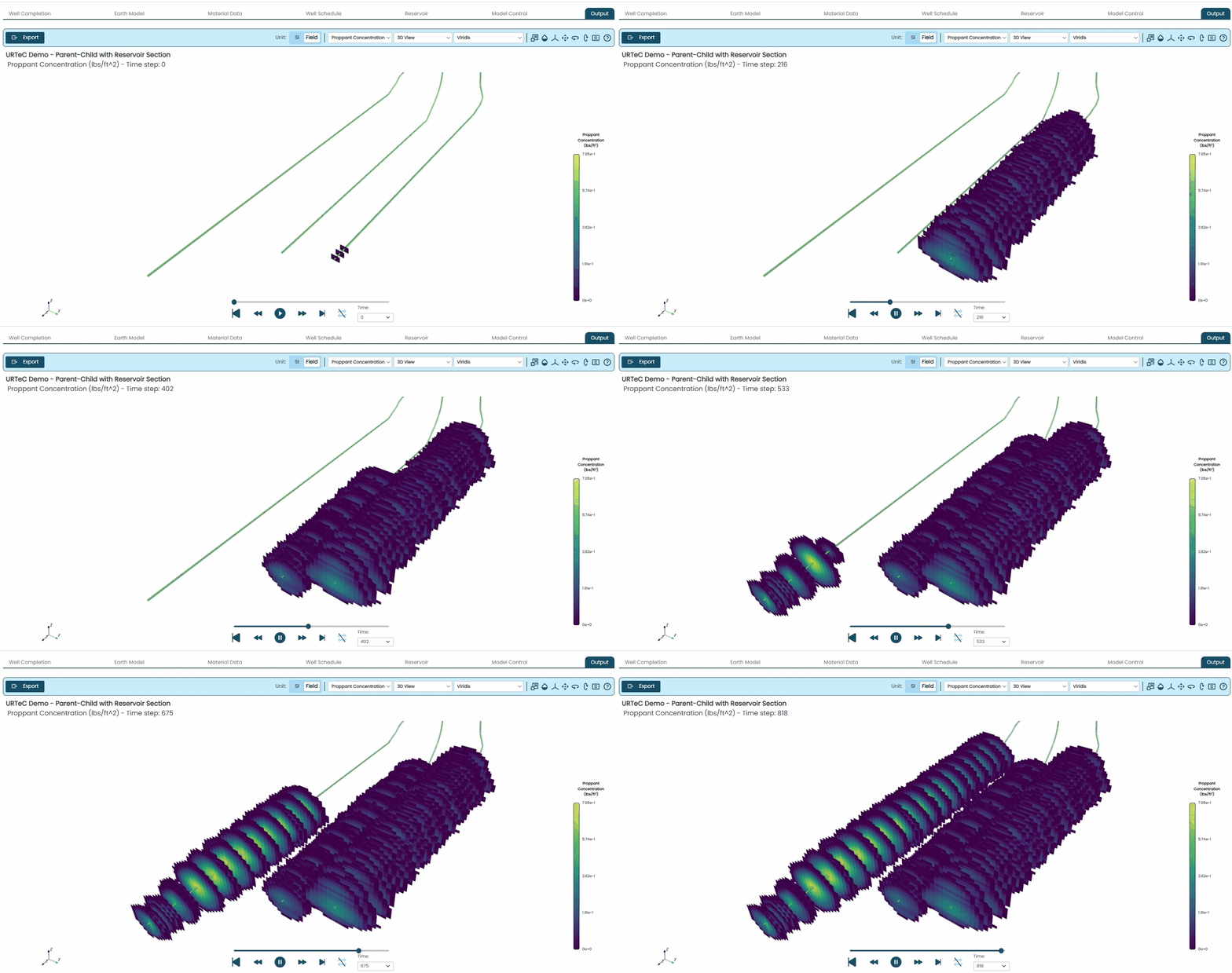
CMG’s new fracture-to-production simulation solution for unconventional development.