We are innovators combining science and technology with deep industry expertise to solve complex subsurface and surface challenges. Learn more about the technology behind our solutions.
CMG has a rich history of bringing industry-first solutions to the market. Our expertise encompasses a broad spectrum of energy workflows and our technology can help energy companies navigate this complex landscape.
We are a global software and consulting company that combines science and technology with deep industry expertise to solve complex subsurface and surface challenges for the new energy industry around the world.
How CMG Reduced CO₂ Storage Simulation Times by Up to 80% While Preserving Area of Review Accuracy
For many CCS projects, the biggest challenge is no longer building a model. It is running enough simulations to support uncertainty analysis, optimization, and regulatory approval.
The regulatory approval depends on demonstrating:
CO₂ plume containment
Pressure propagation
Area of Review (AoR)
Long-term storage integrity
However, the most accurate representation of the aquifer is achieved through explicit high-resolution modelling, an approach that is often required to support regulatory confidence, but that also results in very large models that make optimization and uncertainty analysis prohibitively expensive.
In this study, CMG evaluated multiple approaches for reducing computational complexity in a large-scale saline aquifer storage model containing more than 52 million grid cells, while preserving the accuracy required for regulatory assessments.
Key Insight
For CO₂ storage projects, simulation speed is only valuable if pressure propagation remains accurate. The fastest model is not always the most reliable model.
The Challenge: Regulatory Confidence Requires Large Models
Accurately representing large saline aquifers requires very large simulation models.
In this study, the reference model contained:
52 million active cells
5 CO₂ injectors
25 years of injection
heterogeneous porosity and permeability distributions
Why This Matters
One simulation may be manageable.
Hundreds or thousands of simulations required for:
uncertainty analysis
optimization studies
risk assessment
regulatory workflows
are not.
The question became: How can simulation time be reduced without compromising regulatory accuracy?
Defining What Really Matters: Area of Review
The AoR represents the region where pressure changes or CO₂ migration could affect storage integrity and therefore plays a critical role in permitting and regulatory approval.
For this study, the Area of Review was defined using:
CO₂ saturation thresholds
pressure increase thresholds
These parameters became the benchmark for evaluating every reduced model.
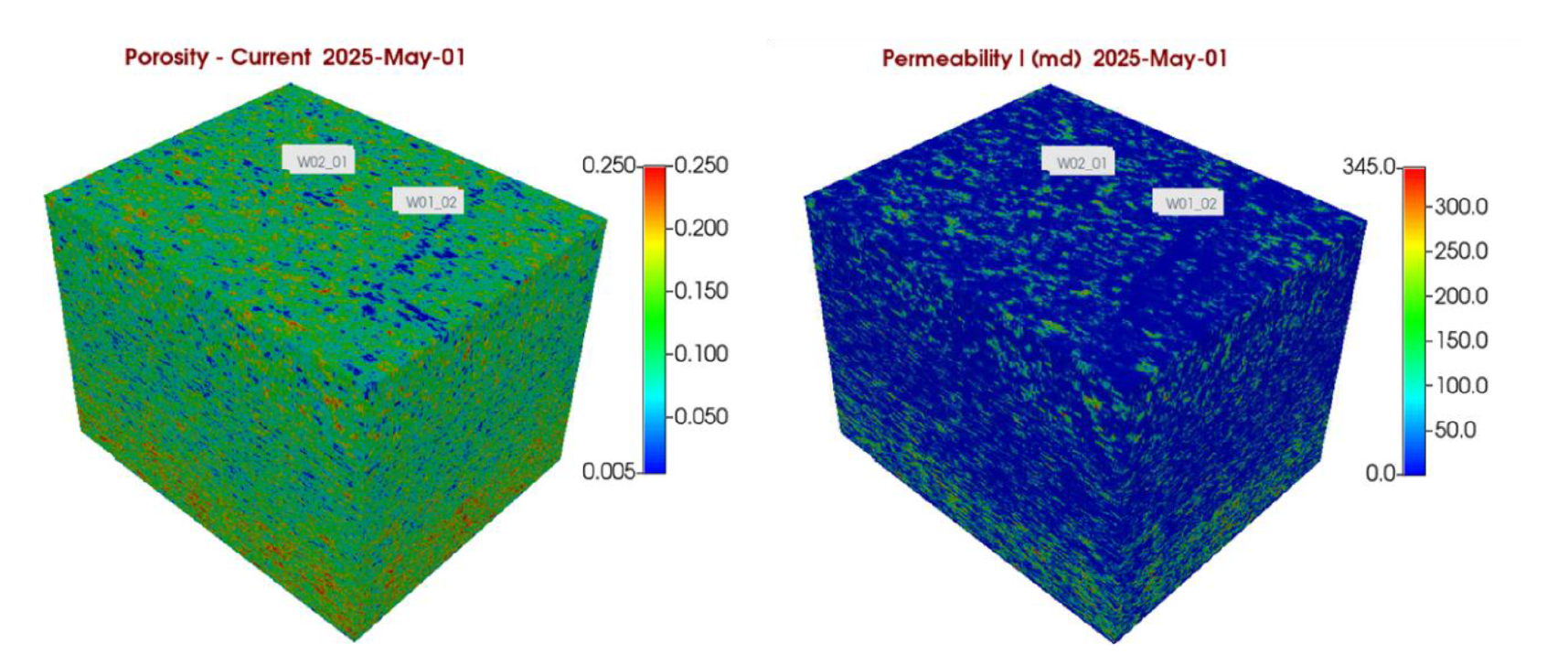
Figure 1: Large-scale heterogeneous saline aquifer model used as the reference case for evaluating model reduction approaches.
Testing Multiple Reduction Strategies
Several methodologies were evaluated:
Analytical aquifers
Flux boundaries
Volume and transmissibility modifiers
Tartan grids
Static amalgamation
Dynamic gridding
Each was assessed using two criteria:
Accuracy of AoR prediction
Simulation time reduction
Insight 1: The Fastest Model Was Not the Most Reliable
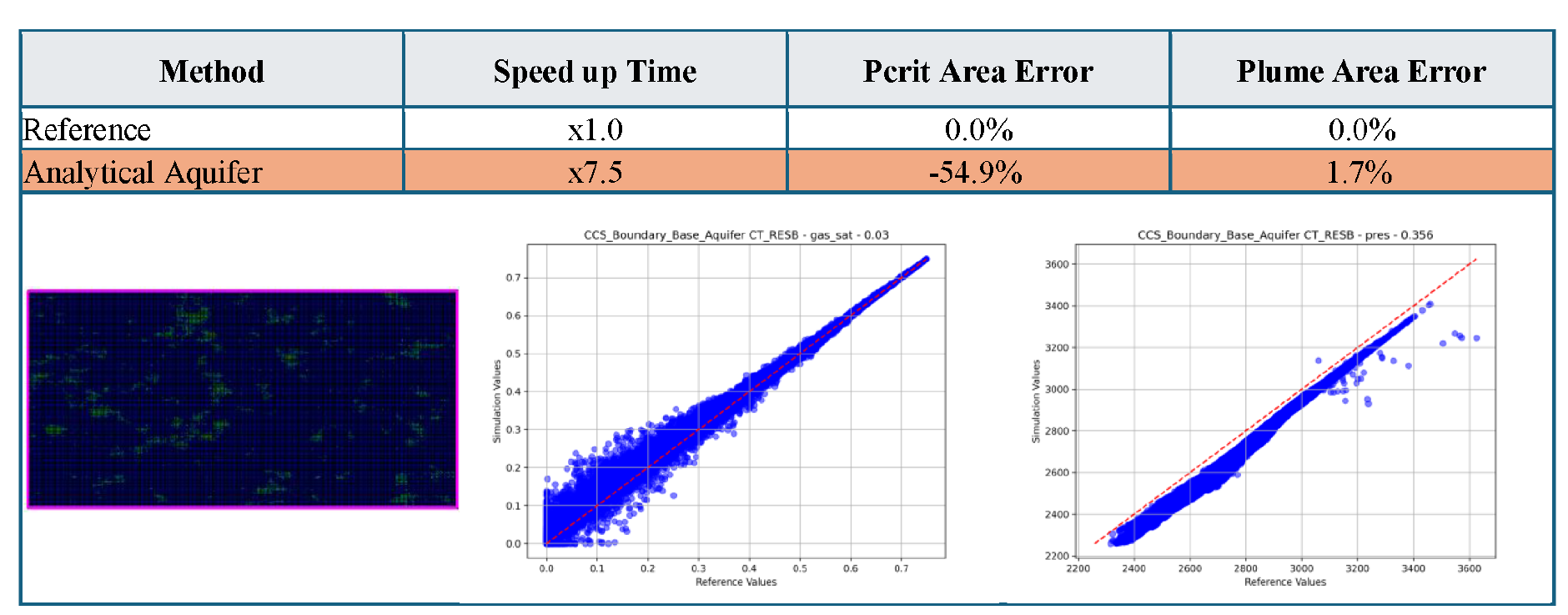
Analytical aquifer models produced the largest computational gains.
Simulation time improved by approximately 7.5x faster
However, pressure propagation accuracy suffered significantly.
Critical pressure area error reached −54.9%
while plume predictions remained relatively accurate.
Figure 2: Analytical aquifer models dramatically reduced runtime but introduced substantial errors in pressure-based AoR calculations.
Insight 2: Pressure Is Harder to Preserve Than the CO₂ Plume
Plume area errors remained below approximately 3% across all approaches.
Pressure propagation, however, proved far more sensitive.
Several techniques that appeared acceptable based on plume matching alone produced significant AoR errors.
Insight 3: Preserving Model Structure Produced Better Results
Methods that retained the original grid architecture consistently delivered more accurate results.
These included:
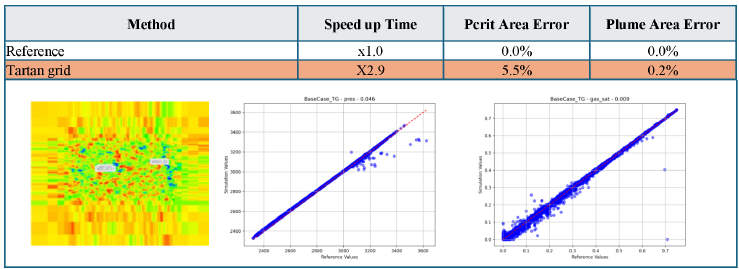
Tartan grids
Static amalgamation
Dynamic gridding
All maintained low pressure errors while still reducing computational effort.
Figure 3: Tartar grid models preserved pressure behavior with minimal AoR error while reducing active model size.
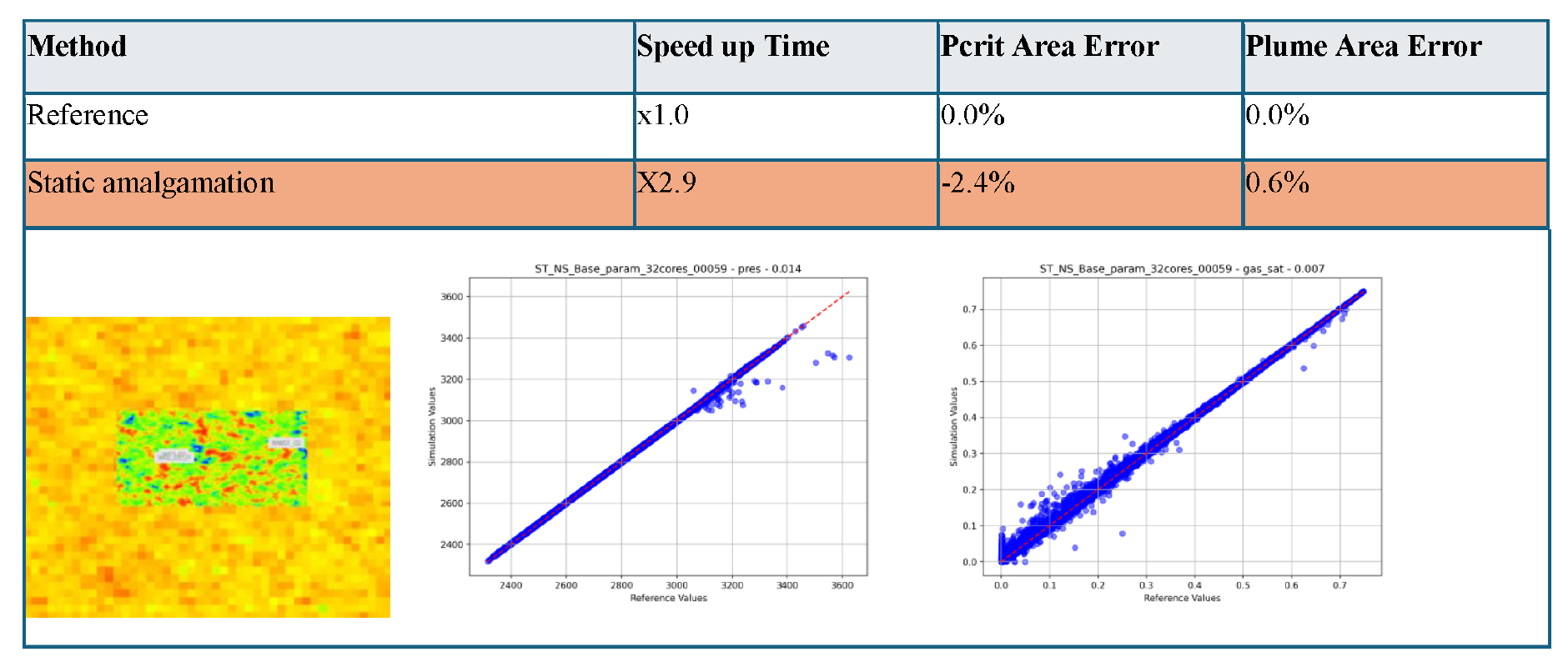
Insight 4: Static Amalgamation Delivered the Best Balance of Speed and Accuracy
Among all methods tested, static amalgamation delivered the best results for both accuracy, speed and ease of implementation.
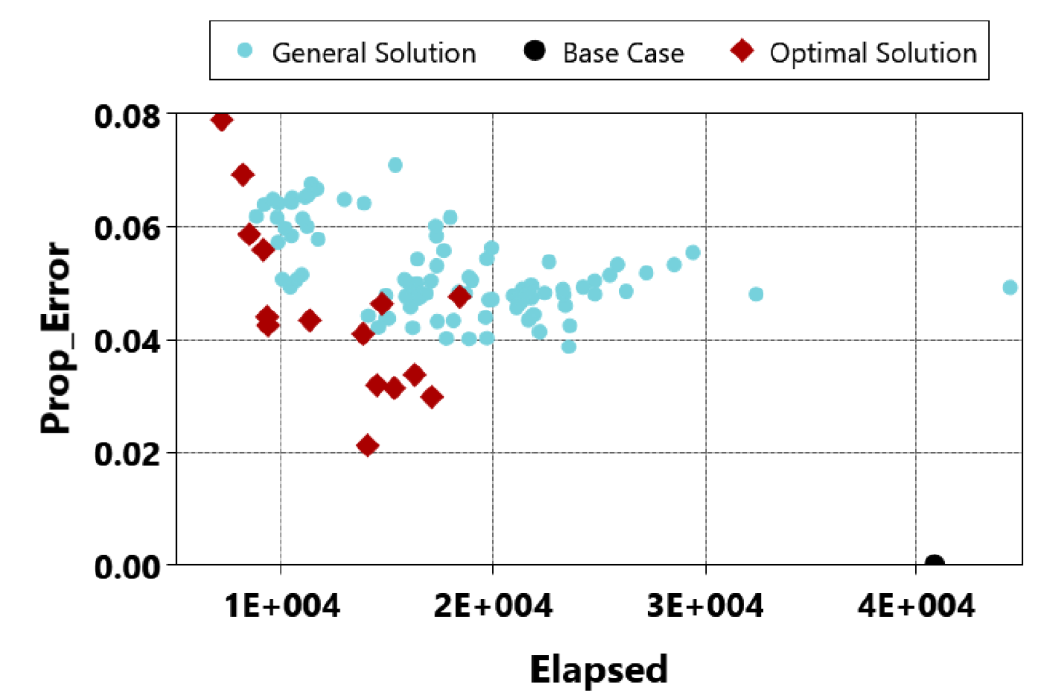
Using CMOST optimization, the team evaluated 110 candidate models and identified an optimal amalgamation strategy.
The resulting model:
reduced simulation time by approximately 80%
maintained AoR error near 3%
preserved pressure behavior
retained plume accuracy
A faster model (higher amalgamation) could be chosen if the error is acceptable.
Figure 4: Multi-objective optimization balancing simulation speed against pressure and plume prediction accuracy.
Figure 5: Static amalgamation achieved one of the strongest results with runtime reduction and AoR accuracy.
Why It Matters
The goal is not simply to create faster models.
The goal is to create models that are:
fast enough for uncertainty analysis
accurate enough for regulatory approval
Static amalgamation achieved both.
Business Impact
Reducing simulation time by up to 80% fundamentally changes what is possible.
Instead of evaluating:
a handful of scenarios
Operators can evaluate:
hundreds of uncertainty realizations
optimization studies
injection strategies
regulatory sensitivities
within practical project timelines.
Why CMG Matters
This study highlights an increasingly important challenge in CCUS:
Regulatory models must be both accurate and computationally practical to ensure that regulatory requirements are met while maximizing storage capacity.
CMG's workflow combined:
GEM for compositional CO₂ storage simulation
CMOST for optimization and calibration
advanced gridding and model-reduction techniques
to preserve the physics that matter most for regulatory decision-making.
Conclusion
For carbon storage projects, the challenge is no longer just building accurate models.
The challenge is building models that are accurate enough for regulatory approval and efficient enough for large-scale uncertainty analysis.
This study demonstrated that not all model-reduction techniques are equal. While some approaches delivered impressive speed gains, they compromised the pressure predictions required for reliable AoR assessments.
By combining GEM, CMOST, and optimized grid-reduction workflows, CMG showed that it is possible to dramatically reduce simulation time while preserving the regulatory metrics that matter most.
Ultimately, for large-scale CO₂ storage projects, the ability to run more, not just larger, simulations enables better decisions.