In mature oil fields, high-water-cut wells are often viewed as liabilities and candidates for abandonment due to declining hydrocarbon production and rising operating costs.
But in Ecopetrol's Llanos Orientales asset in Colombia, those same wells contained something valuable that had never been fully quantified: Thermal energy.
Using a coupled geothermal simulation workflow in CMG STARS, the team evaluated whether produced water from mature wells could become a viable low-enthalpy geothermal resource.
The study integrated:
- thermal reservoir simulation
- production history
- coupled wellbore heat-loss modelling
- surface thermal energy estimation
Outcome: For Ecopetrol, the results revealed that many high-water-cut wells could deliver:
- >4.5 × 10⁷ BTU/day of usable thermal energy
- equivalent to hundreds of kW of continuous heat
- with minimal modification to existing infrastructure
The Challenge: Mature Wells with Declining Oil Value
Ecopetrol's Llanos Orientales field is a mature producing asset characterized by:
- declining oil production
- increasing water cut
- growing abandonment candidates
At the same time:
- reservoir temperatures averaged ~250°F
- more than 110 wells had already been drilled
- large volumes of hot produced water were continuously reaching surface
Reframing the Problem
Traditionally, high-water-cut wells are viewed as:
- uneconomic producers
- operational burdens
- abandonment liabilities
But from a geothermal perspective, they represent something different:
A continuously flowing heat source connected to existing infrastructure.
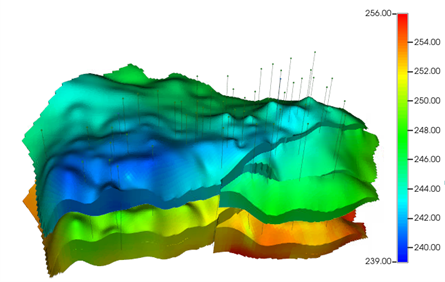
Figure 1. Mature High-Water-Cut Wells Reframed as Geothermal Opportunities
Mature wells with declining hydrocarbon value still retain significant thermal energy in produced water streams, creating potential for geothermal repurposing.
Why Thermal Simulation Matters
Estimating geothermal potential is not as simple as knowing reservoir temperature.
The usable energy at surface depends on:
- heat losses along the wellbore
- production rates
- tubing design
- pressure and temperature evolution
- reservoir heat distribution
Reservoir temperature alone does not determine usable geothermal energy.
The critical question is: How much heat actually reaches surface?
Solution: Coupling Reservoir and Wellbore Physics using CMG STARS
The workflow integrated:
- dynamic reservoir simulation
- temperature distribution modeling
- coupled wellbore heat-loss calculations
- production history matching
Model Overview
The thermal-compositional model included:
- 1.59 million grid blocks
- 112 wells (producers + injectors)
- temperature gradients with depth
- heterogeneous reservoir properties
- water injection at surface temperature
The workflow captured coupled thermal and flow processes, including heat transfer in the reservoir and thermal losses along the wellbore.
Coupled Wellbore Modelling
A semi-analytical vertical flow model was coupled directly with the reservoir simulation to calculate:
- bottomhole pressure and temperature
- pressure losses inside tubing
- temperature losses from reservoir to surface
The model also captured:
- thermal resistance through tubing, casing, annulus, and cement
- frictional and gravitational effects
- Joule-Thomson behavior near perforations
Thermal Mapping of the Reservoir
Thermal simulation generated field-scale temperature distributions, identifying zones with:
- higher geothermal gradients
- stronger heat delivery potential
- better pilot implementation opportunities
Key Results & Insights
1. High-Water-Cut Wells Delivered Significant Thermal Energy
Simulation results showed that many mature producers delivered:
- >4.5 × 10⁷ BTU/day of usable thermal energy
- equivalent to several hundred kW of continuous heat
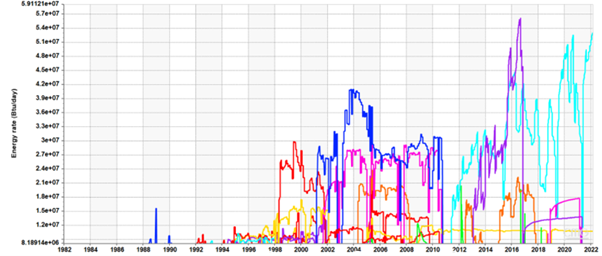 Several mature producers demonstrated strong geothermal potential based on flow rate, temperature stability, and thermal delivery at the surface.
Insight:
High-water-cut wells were often the strongest geothermal candidates because large produced water volumes carried substantial thermal energy to surface.
2. Surface Heat Depends Strongly on Wellbore Heat Loss
The study showed that:
- tubing design
- well geometry
- thermal insulation properties
all strongly influenced how much heat ultimately reached the surface.
Insight:
Reservoir heat alone is insufficient. Wellbore heat-loss modelling is essential for realistic geothermal assessment.
3. Existing Infrastructure Reduced Development Requirements
Many candidate wells required:
- minimal surface modification
- no new drilling
- reuse of existing production infrastructure
The workflow identified immediate pilot candidates while also evaluating heat-loss sensitivity, tubing design effects, and long-term thermal stability.
Insight:
Wells originally considered abandonment candidates became potential energy-transition assets.
The Bigger Opportunity
Instead of:
abandoning high-water-cut wells
Operators may be able to:
repurpose them into distributed geothermal energy systems.
Why This Matters
This study required more than conventional reservoir simulation.
CMG STARS enabled:
- coupled thermal-compositional simulation
- dynamic temperature tracking
- integrated wellbore heat-loss calculations
- surface thermal energy estimation
- field-wide geothermal screening
The workflow quantified reservoir temperature and usable geothermal energy delivered at the surface.
Key Takeaways
- High-water-cut wells can become geothermal assets
- Reservoir temperature alone does not define geothermal potential
- Wellbore heat-loss modelling is critical for realistic energy estimates
- Existing infrastructure can significantly reduce development requirements
- Thermal simulation enables field-wide geothermal screening and ranking
Conclusion
For Ecopetrol, this workflow transformed geothermal evaluation from a conceptual opportunity into a data-driven screening strategy, enabling the identification of high-potential wells using existing production data and infrastructure.
By integrating reservoir heat distribution, production history, and wellbore heat-loss modelling within CMG STARS, the team was able to identify wells capable of delivering meaningful geothermal energy with minimal additional infrastructure.
Ultimately, the workflow transformed high-water-cut wells from abandonment candidates into potential energy-transition assets, providing a replicable methodology for geothermal evaluation in mature fields worldwide.