
Fast today. Faster tomorrow. Trusted physics throughout.
Independent UNISIM testing measured IMEX runtimes up to 70% shorter on GPU.
On average, GEM is 1.8x faster on CPU than a year ago and 1.6x faster on GPU than on CPU, with the same physics on both.
SPE10 at 64 cores, across 2019 to 2024 releases
Average runtime and up to 2.8x on some models across 2025 to 2026 releases
Independently evaluated by UNISIM, CEPETRO/UNICAMP
Average runtime with more than 3x on large models
Faster on the hardware you have.
Faster again on GPU.
Not every team runs GPUs, so CMG keeps pushing CPU performance too. Here is what each path delivers today and in the future.
9x faster than the 2019 release
On SPE10 at 64 cores on the same machine from about 683 seconds to 78 seconds across the 2019 to 2024 releases.
1.8x faster since 2025
Average across benchmark models on the same machine, from the 2025.11 to the 2026.11 release. Up to 2.8x on some models.
1.3x faster FlexWell calculations
Average speedup on CPU, with faster well designs for thermal models in STARS.
Up to 2.4x faster than CPU
On production-scale models, on top of the CPU gains, with the GPU switched on. Up to 70% shorter runtimes in independent testing, and SPE10 in about 32 s on one Grace Hopper superchip.
1.6x faster than CPU on average, 3x+ on large models
Total runtime with the GPU switched on. The solver alone runs 3.3x faster on average and up to 5.7x.
GEM in January 2027
for models too large for a single GPU, followed by IMEX in the first half of 2027.
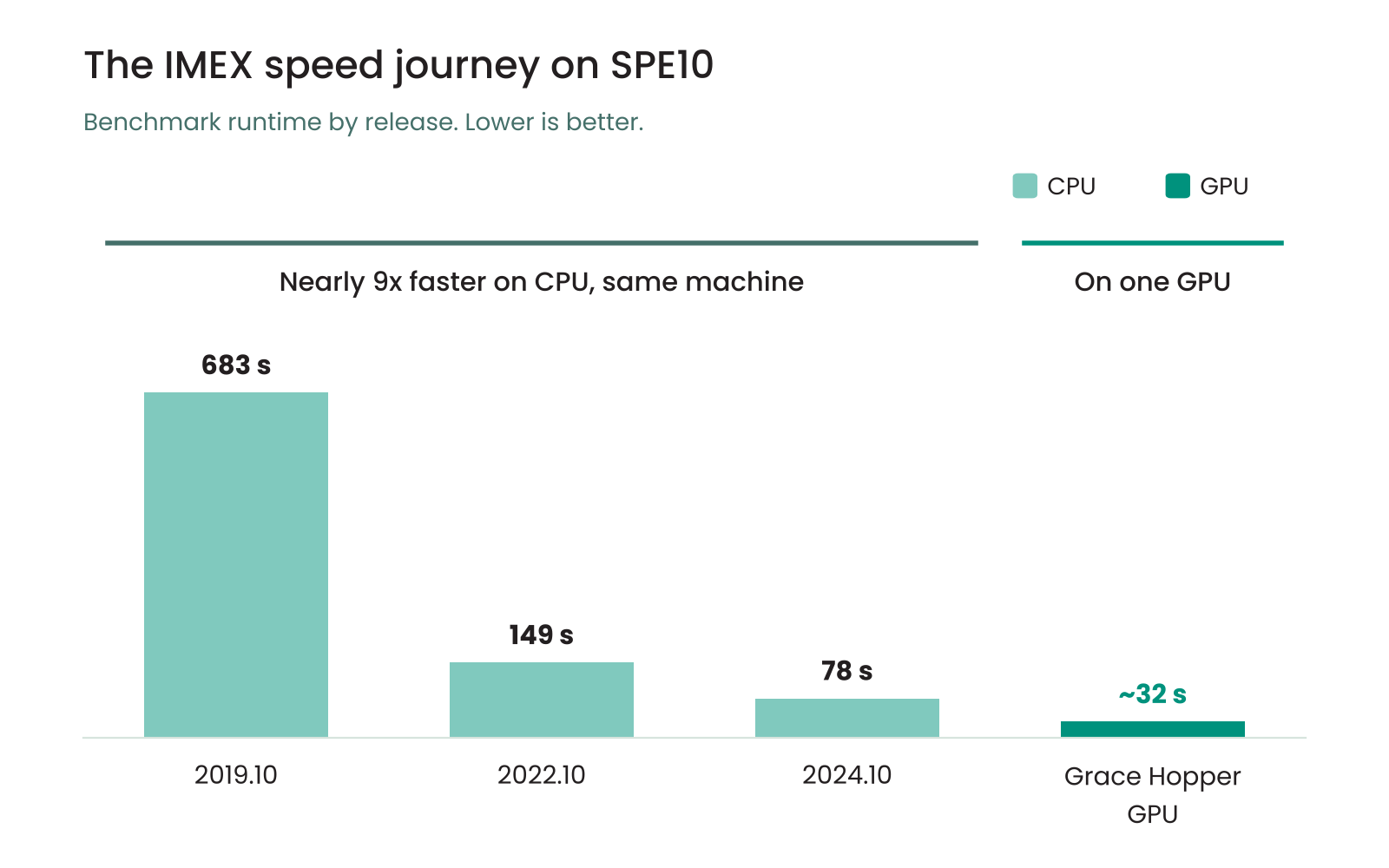
IMEX SPE10 runtimes: 2019.10 to 2024.10 releases on the same 64-core machine. IMEX GPU runtime on one NVIDIA Grace Hopper superchip
Don't take our word for it.
The UNISIM research group at CEPETRO/UNICAMP benchmarked IMEX 2025.30 on NVIDIA A30 and A100 GPUs against CPU-only runs, on two public black-oil models, with no involvement from CMG. They measured runtimes up to 70% shorter and recommended GPU for models with many cells.

IMEX on GPU
53-70%
runtime reduction across both models and every CPU core count tested
UNISIM, CEPETRO/UNICAMP
2.1-3.3x
speedup on GPU versus CPU-only runs
UNISIM-I-R and UNISIM-II-R
Now compositional, too. And the
bigger the model, the bigger the gain.
GEM brings GPU acceleration to compositional and unconventional studies, validated out of the box on models of many sizes and problem types.

average
on larger models
Explore more of the uncertainty, not just finish sooner.
More realizations, sensitivities, and history-match iterations in the same project window.
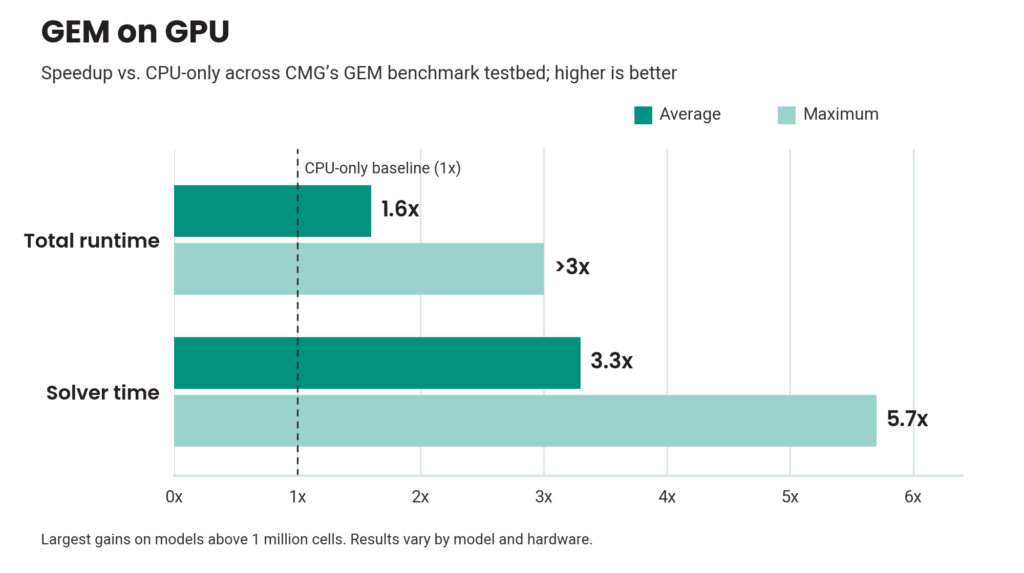
Measured on CMG’s GEM benchmark testbed against at 64-core CPU baseline. Total runtime covers the full simulation; solver time covers the solver alone.
Faster shouldn't
change the answer
Speed only matters if engineers can trust the result. Every GPU release is cross-checked and compared against non-GPU equivalent runs to ensure consistency.
In this field model validation example, 26 years of operations are run both ways, with the GPU results sitting directly on the CPU results.
- The same physics and the same input data
- No need to rebuild existing models
- Results that agree well within engineering tolerances
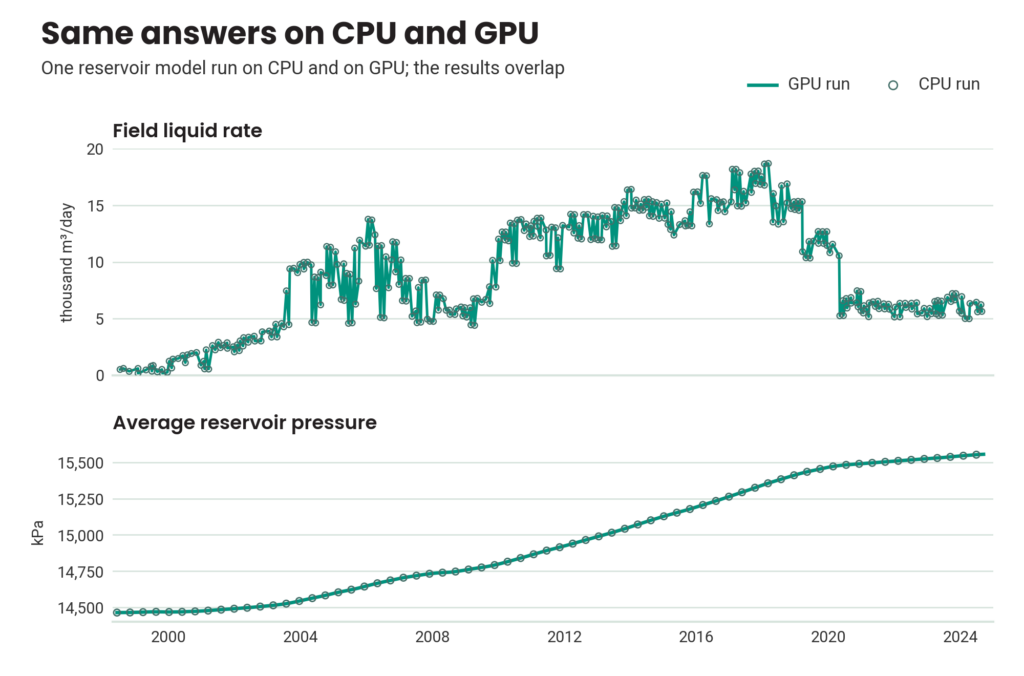
The same reservoir model was run on the CPU and on the GPU. As with any change of hardware, calculations can run in a slightly different order, so results may differ in the last decimal places.
Performance isn't a
destination. It's a release cycle.
We continuously invest in performance so our users can take advantage of modern computing. Here is where we have been, and what comes next.
IMEX 9x faster
SPE10 runtime at 64 cores: 683 seconds to 78 seconds
IMEX on GPU
SPE10 runtime about 32 seconds on one GPU
GEM on GPU
Compositional and unconventional studies
GEM multi-GPU
For models too large for a single GPU
IMEX multi-GPU
Multi-GPU extends to black-oil studies
STARS on GPU
Thermal and advanced-processes
Planned dates are targets and may change. Published in November 2026.
Don't benchmark runtime in
isolation. Benchmark the solution.
Two simulations can finish in the same time and still cost very different amounts to run. Before you compare the speed, five questions to consider.
01
What was the runtime?
The obvious starting point, but not where analysis ends.
02
What hardware did it need?
CPU cores, number of GPUs, memory and infrastructure.
03
What was actually simulated?
Equivalent physics and model configuration, or a shortcut?
04
What did it take to scale?
Does more compute need more licenses to unlock it?
05
What did the answer cost?
Hardware, compute and software access, all together.
Performance should be powerful. Pricing should be simple.
How CMG licensing works when you move to GPU.
Included with your current license.
Move licenses between CPU and GPU machines.
Multi-GPU included with the IMEX and GEM MAX licenses.
GPU Reservoir Simulation: How CMG Went From a Gaming Card to Multi-GPU
It started with one developer, an early prototype and a gaming graphics card in an office workstation. Arash Mirzabozorg explains how IMEX and GEM made it to the GPU, how every GPU result is checked against the CPU, and what multi-GPU changes for the largest models.

Arash Mirzabozorg
Manager, Software Development
The same trusted physics, the same input data, and significantly less time waiting.
Faster results on the models you already run
Every model starts somewhere different. We help customers close the gap with the latest CMG release, the right numerical settings, the right hardware and a guided setup for their team. Here’s what that delivered over the past year. Customer names and model details are withheld.
9 days →
8 hours
Multi-pad SAGD model: latest CMG release, improved numerical controls, and more cores.
16.8 hours →
3.2 hours
2.7 hours on the latest hardware and an appropriate number of cores for the model size in the cloud.
15 hours →
2.7 hours
Newer hardware, MPI and model optimization on 64 cores.
About 1.3 hours in the cloud.
6 weeks →
2 days
Coupled CO2-brine-rock geochemistry with long-term mineralization, using auto tuning. About 1.4 hours in the cloud.
20+ hours →
under
3 hours
Auto tuning and a 64-core parallel run.
11 hours →
4h 20min
IMEX with GPU, compared with another simulator’s GPU run, after converting the model, with a better history match.*
Results from CMG client engagements, 2025 to 2026, on customers’ own models, checked against the original runs. Results vary by model and hardware.
*Run on different hardware.
Bring your toughest model. We'll run it. You compare.
Published benchmarks are a starting point. Your own model is the real test. Send it to us and our engineers will run it on CMG, on CPU, GPU or both, so you can compare runtime, hardware and results with whatever you use today.
- Black oil, compositional or thermal
- Results reviewed with a CMG engineer
- Your model handled under NDA
Request a benchmark run
"*" indicates required fields
Frequently Asked Questions
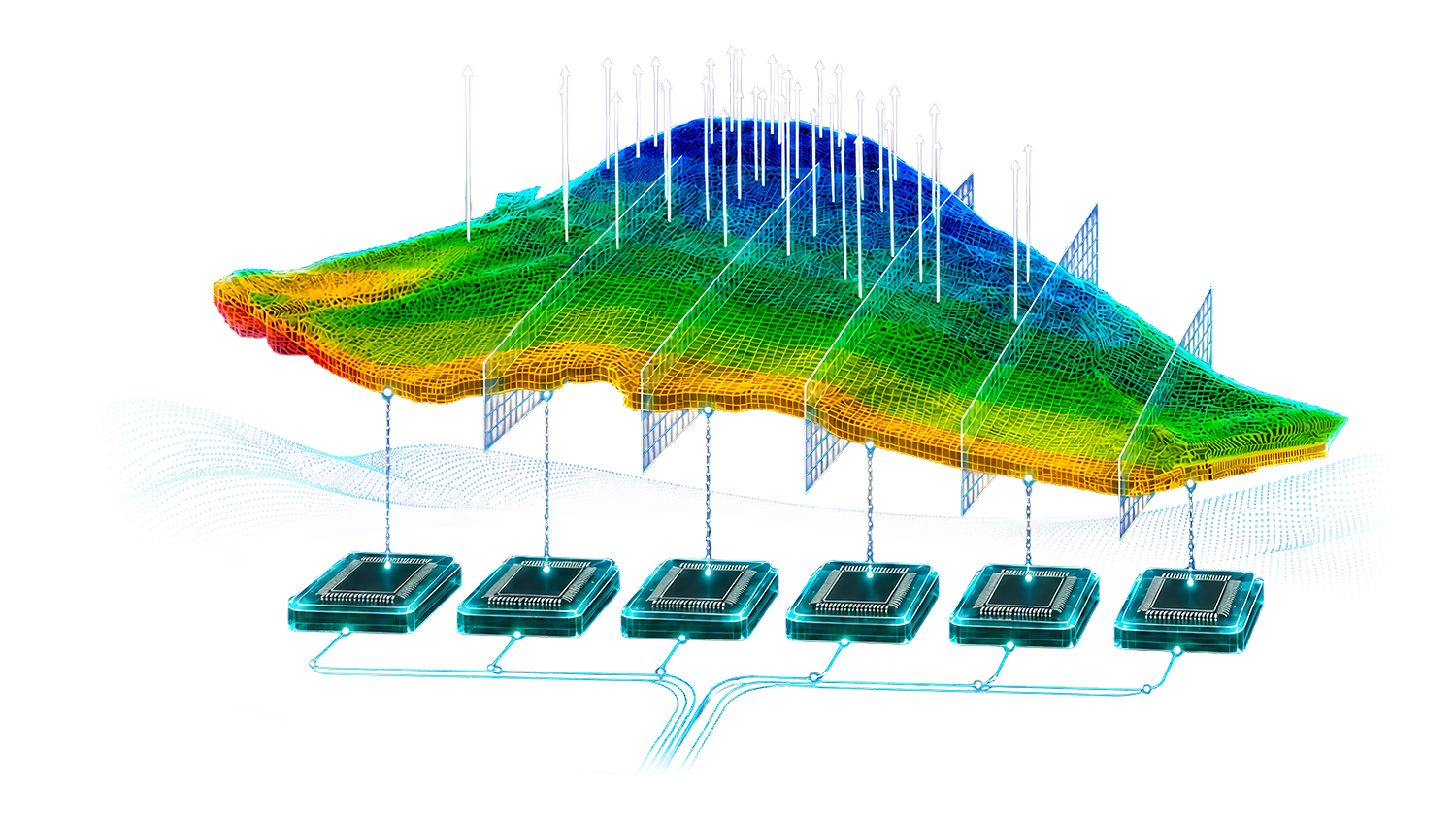
It means running the heavy calculations of a reservoir simulation on a graphics processing unit (GPU) rather than only on the central processing unit (CPU). A reservoir model consists of millions of grid cells whose arithmetic can be carried out side by side, which suits the thousands of cores in a GPU and reduces runtimes on large models.
IMEX has been commercially available on GPU since 2025, and GEM followed in September 2026. GPU acceleration for STARS is planned for the second half of 2027.
On the SPE10 benchmark, IMEX on a single NVIDIA Grace Hopper superchip finishes in about 32 seconds. On the same machine with the GPU switched on, CMG measured speedups of up to 2.4 times on production-scale models, and independent testing by UNISIM at CEPETRO/UNICAMP found runtimes up to 70% shorter.
Across CMG’s GEM benchmark testbed, switching on the GPU made runs 1.6 times faster on average, and more than three times faster on large models above one million cells.
Yes. GPU runs use the same physics and the same input data as CPU runs, and CMG verifies that GPU results match CPU results on the same models, so switching on the GPU changes how long a run takes, not what it tells you.
No. GPU acceleration works with the same input data engineers already use, so existing models can run on the GPU without being rebuilt.
GPU runs are supported on Linux: directly on Red Hat Enterprise Linux 8 or higher, or on any modern Linux distribution through a CMG-provided Docker image. You’ll need an NVIDIA GPU with compute capability 7.0, 8.0 or 9.0 (for example the V100, A100 and H100 generations) and CUDA driver 535.86 or higher.
Larger models gain the most. CMG’s own benchmarks and independent testing by UNISIM both found the biggest speedups on models with many grid cells, typically above one million.
Multi-GPU simulation divides a reservoir model into regions, each handled by its own GPU, so models too large for one GPU’s memory can run in full. Multi-GPU support for GEM is planned for January 2027, followed by IMEX in the first half of 2027.
GPU acceleration is included with IMEX and GEM license. Multi-GPU support will be included with the MAX licenses of IMEX and GEM. Your CMG account manager can confirm which licenses you have.