The short version
CMG's IMEX and GEM reservoir simulators now run on GPU, and multi-GPU support for GEM is planned for January 2027. IMEX runtimes were up to 70% shorter on GPU in independent testing by UNISIM at CEPETRO/UNICAMP, and GEM runs 1.6 times faster on GPU than on CPU on average. This article, by Arash Mirzabozorg, Manager, Software Development, explains how CMG got there and what multi-GPU changes for the largest models.
SPEED AND RISK. In the subsurface business, those two words shape nearly every decision. Whether a company is developing an oil and gas field, storing hydrogen underground, or permanently locking away captured carbon dioxide, it must understand the physics of rock and fluid, and the uncertainty around them, before committing capital. Simulation was once reserved for long-range plans and research projects. Today, operators want to run more scenarios on bigger models, under tighter deadlines, and want simulation in the room when operational decisions are made.
That shift has turned raw computing speed into a strategic asset. For more than a decade, CMG’s simulators have set the pace on conventional processors. The next chapter is being written on a very different kind of chip.
How much faster are CMG simulators on GPU?
CMG’s IMEX™ and GEM™ reservoir simulators already run on GPU, giving engineers faster answers on bigger, more detailed models. Multi-GPU support and GPU-accelerated STARS™ are next.
Faster on CPU first. Between the 2019 and 2024 releases, IMEX became nine times faster on the SPE10 benchmark on CPU, from about 683 seconds to 78. GEM became 1.8 times faster on CPU on average from the 2025.11 to the 2026.11 release, and up to 2.8 times faster on some models.
Then faster again on GPU. With the GPU switched on, IMEX runs up to 2.4 times faster than on CPU on production-scale models. On a single NVIDIA Grace Hopper superchip, SPE10 now completes in about 32 seconds.
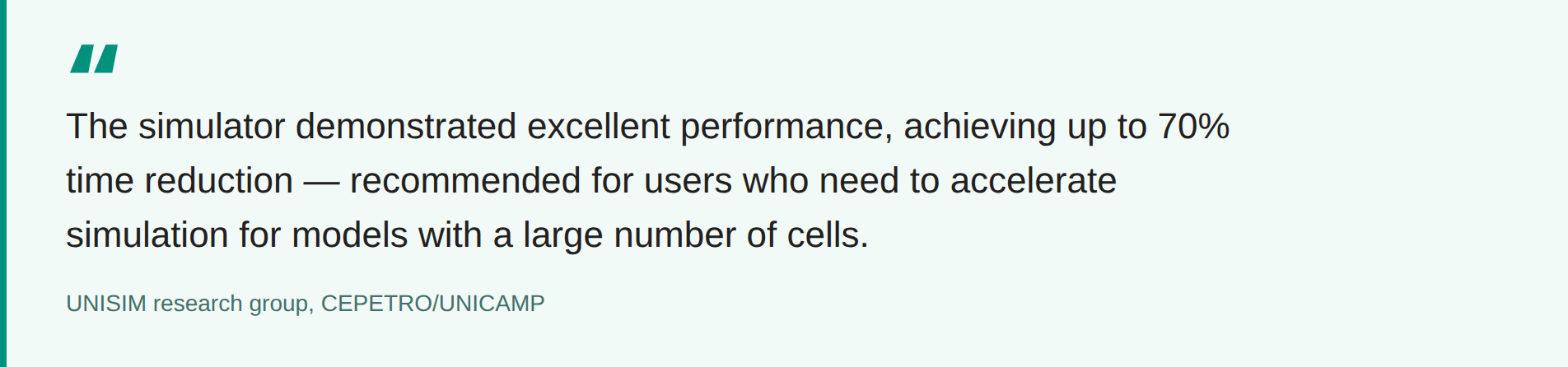
Independently validated. The UNISIM research group at CEPETRO/UNICAMP measured runtimes up to 70% shorter than CPU-only runs (2.1 to 3.3 times faster) for IMEX 2025.30 on NVIDIA A30 and A100 GPUs, with no CMG involvement.
GEM on GPU. With the September 2026 release, CMG’s compositional simulator runs 1.6 times faster than on CPU on average, and more than three times faster on large models.
What’s next. Multi-GPU support for GEM is scheduled for January 2027, followed by IMEX multi-GPU in the first half of 2027 and STARS on GPU in the second half of 2027.
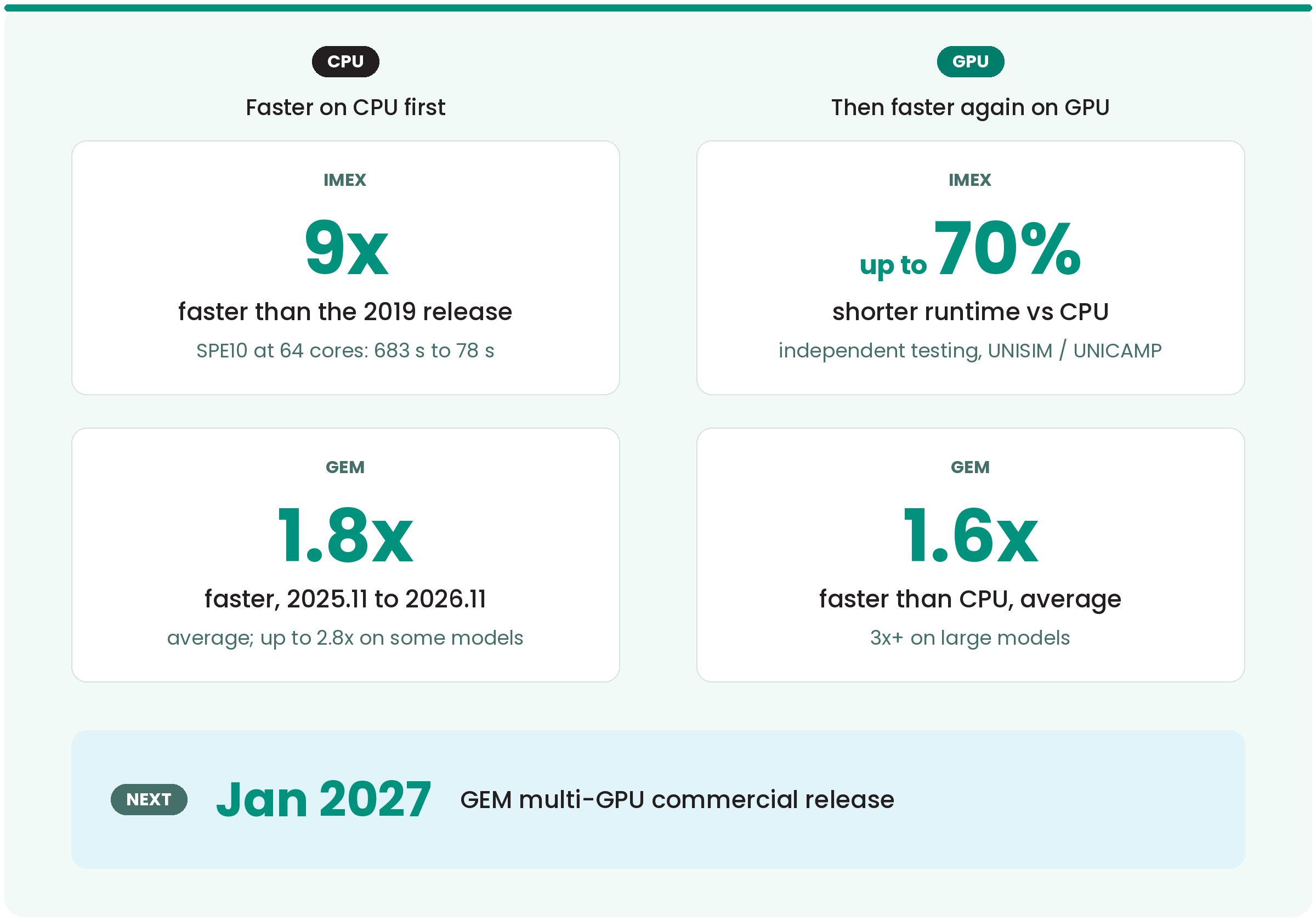
9x faster IMEX with SPE10 on CPU by upgrading from 2019 to 2024 release; 1.8x faster GEM on CPU from 2025.11 to 2026.11; up to 70% shorter IMEX runtime on GPU vs CPU (UNISIM/UNICAMP); 1.6x faster GEM on GPU vs CPU on average, 3x+ on large models; GEM multi-GPU commercial release January 2027. Published in November 2026.
01. T H E T E C H N O L O G Y
What is a GPU, and why does it matter?
A graphics processing unit, or GPU, was built to render video games, where millions of pixels must be updated at the same instant. That design, known as massive parallelism, has made the GPU the engine of the artificial-intelligence boom, and AI investment is now pushing GPU performance forward far faster than CPUs are improving.
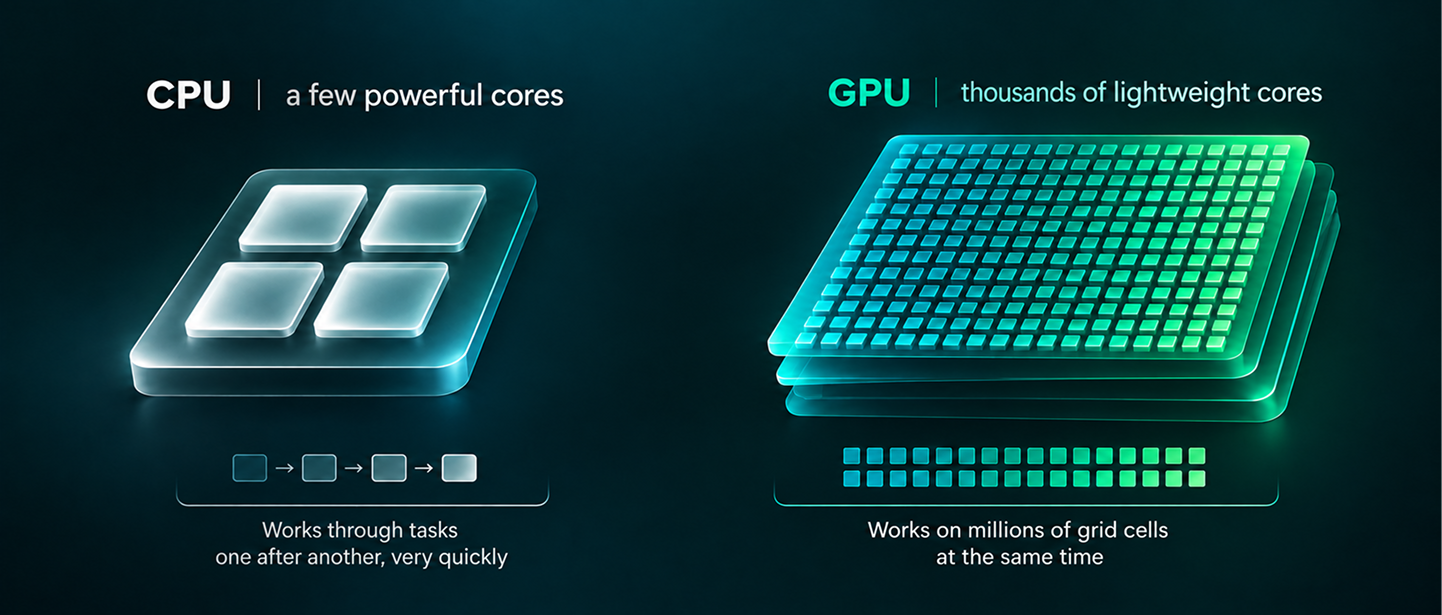
Reservoir simulation is a strikingly good fit. A model divides the subsurface into millions, sometimes billions, of small grid cells, and much of the arithmetic for each cell can be carried out side by side. GPUs also move data through memory at very high bandwidth, which matters when a model holds tens of millions of cells and must be updated thousands of times over a forecast.
WHY IT MATTERS TO THE BUSINESS
▸ Faster answers. Overnight studies finish the same morning.
▸ More scenarios. Explore a wider range of uncertainty in the same time window.
▸ Bigger, sharper models. Keep geological detail instead of simplifying it away.
“
A CPU is a small team of brilliant generalists. A GPU is a stadium full of specialists working in unison.
THE CORE IDEA BEHIND GPU COMPUTING
02. O U R J O U R N E Y
Why did CMG move to GPUs?
By 2019, IMEX, our black-oil simulator, was already a fast, mature CPU code, and we kept pushing it. Between 2019 and 2024, our engineers made it nearly nine times faster on CPU, cutting the SPE10 benchmark, the industry’s standard stress test for simulators, from about 683 seconds to 78 on the same machine.
At the same time, the hardware landscape was shifting. Driven by AI, GPUs were improving far faster than CPUs, and simulation was a natural fit: a reservoir model is millions of grid cells, each needing similar calculations that can run side by side. We saw where the hardware was heading, and staying ahead would require a first-class GPU strategy.
The first experiment was refreshingly modest: one of our developers ran an early prototype on a gaming graphics card in an office workstation. It delivered a speedup straight out of the gate. That result earned dedicated investment and led to a technical partnership with NVIDIA, aimed at a commercial, dependable GPU product rather than a lab curiosity.
Moving a mature, physics-rich simulator to a GPU isn't as simple as copying it over. It meant rethinking how the work is divided, how data moves between processors, and how we verify every result, so GPU answers match the quality engineers already trust.
We chose IMEX as the starting point. We've already proven its speed against the market, and it supports conventional and black-oil studies where turnaround time is often the deciding factor.
In parallel, we enabled IMEX on ARM processors, unlocking strong results on NVIDIA’s Grace Hopper superchips, which pair an ARM CPU and a data-center GPU in a single package. In 2025, on SPE10, IMEX on a single Grace Hopper superchip finished in about 32 seconds.
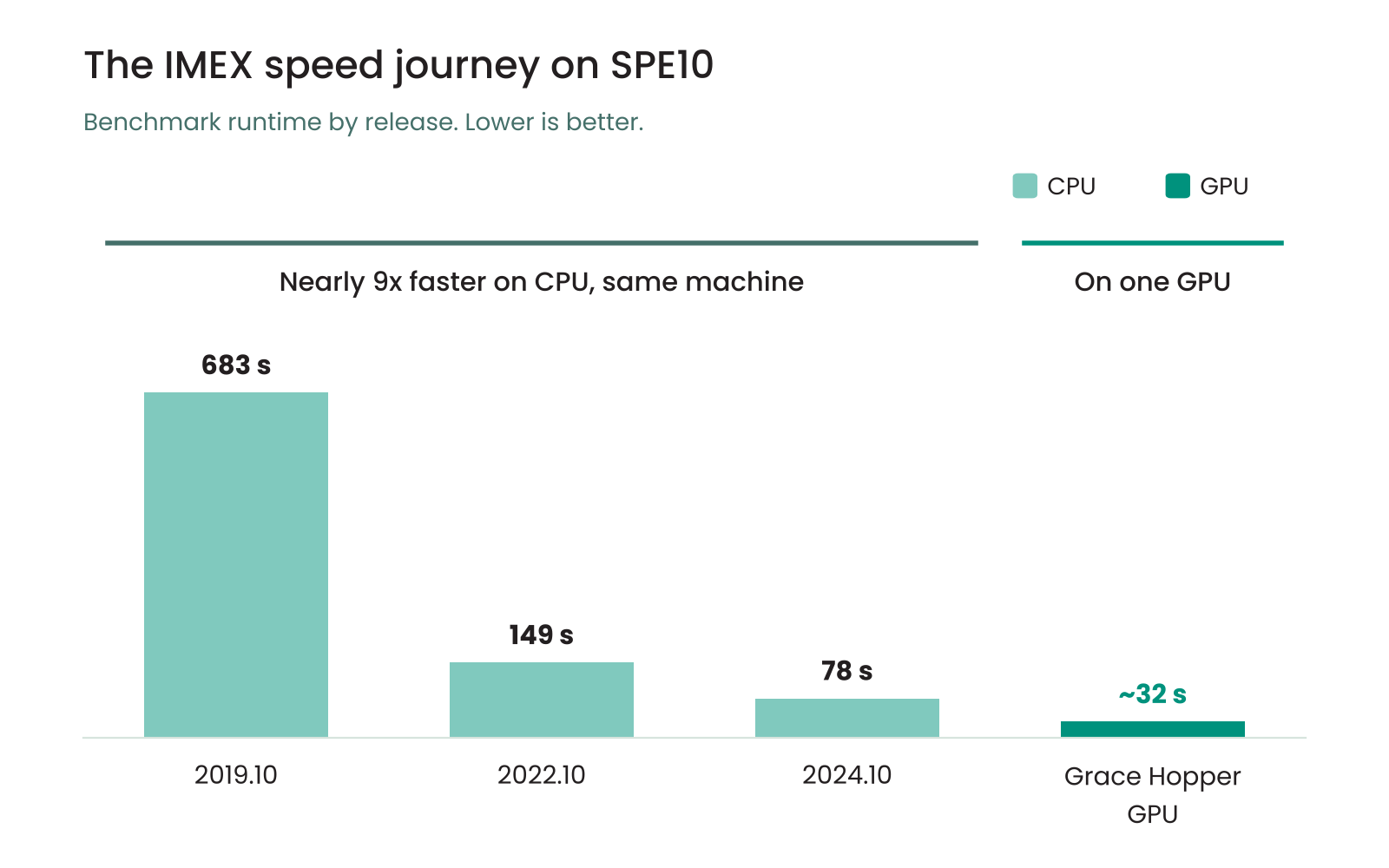 IMEX SPE10 runtimes: 2019.10 to 2024.10 releases on the same 64-core machine. IMEX GPU runtime on one NVIDIA Grace Hopper superchip
03. P E R F O R M A N C E
Does the GPU give the same answers as the CPU?
Speed only matters if engineers can trust the result. Every GPU release is cross-checked and compared against non-GPU equivalent runs to ensure consistency. In this field model validation example, 26 years of operations are run both ways, with the GPU results sitting directly on the CPU results.
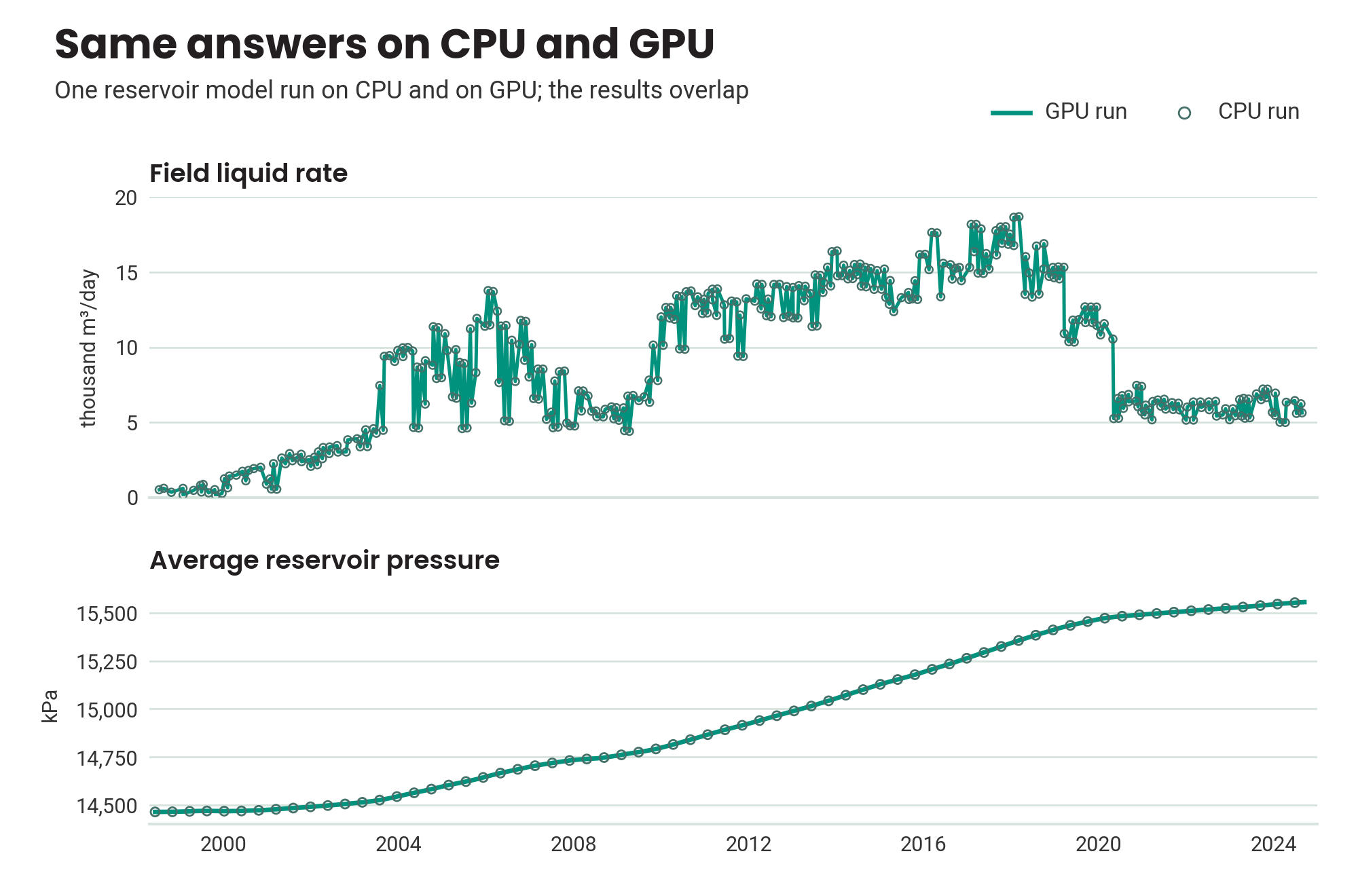
The same reservoir model was run on the CPU and on the GPU.
As with any change of hardware, calculations can run in a slightly different order, so results may differ in the last decimal places, but they agree well within the tolerances engineers work to.
How much faster is IMEX on GPU vs. CPU?
Throughout development, a large test bed of template, project, client, and industry models was benchmarked continuously. Simply switching on the GPU made runs faster across the board, with gains of up to 2.4 times on production-scale models of a million cells and more. The pattern is consistent: the bigger and more demanding the model, the larger the payoff.
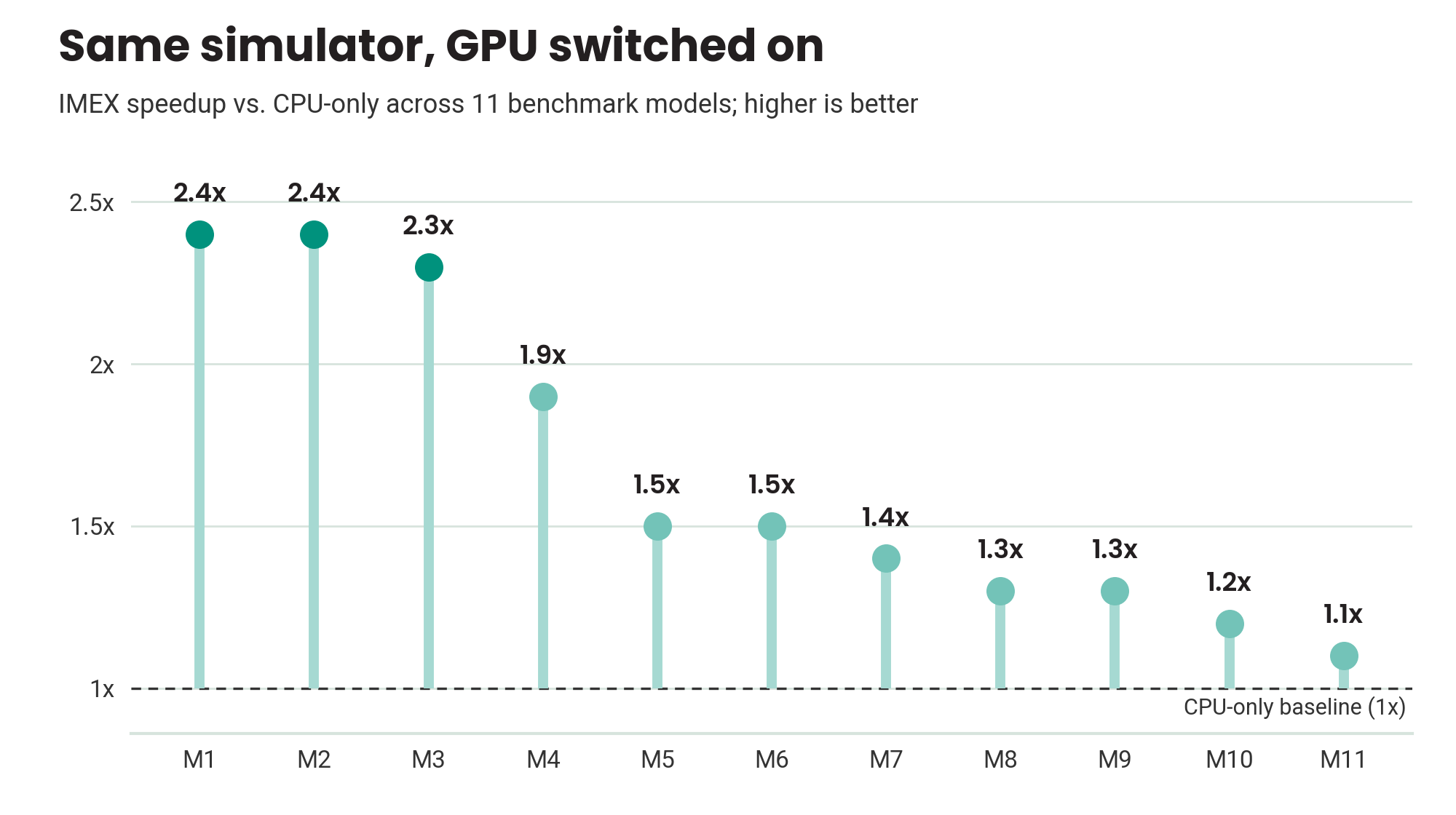
CMG internal benchmarking, same machine with and without GPU.
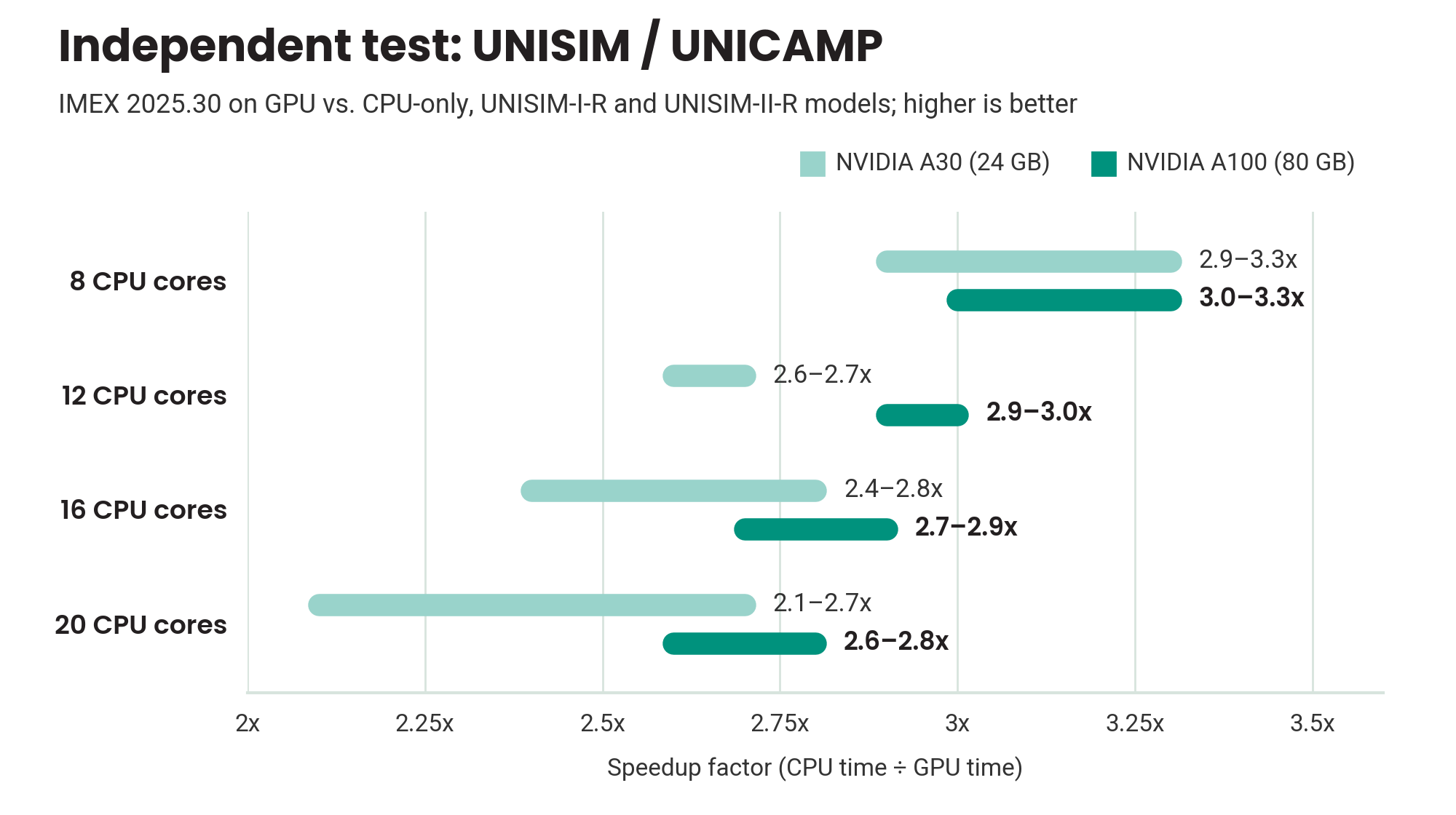
Independent results: UNISIM measured IMEX 2025.30 on NVIDIA A30 and A100 GPUs against CPU-only runs with 8, 12, 16 and 20 cores. GPU speedups ranged from 2.1x to 3.3x across both models.
How does GEM perform on GPU?
GEM, our compositional simulator, followed. Its richer physics and larger models created new demands for robustness, and we have since validated out-of-the-box GPU speedups on GEM models of many sizes and problem types.
Across CMG’s GEM benchmark testbed, switching on the GPU made runs 1.6 times faster on average, and more than three times faster on large models. The solver itself, the compute-heavy part of each run, ran 3.3 times faster on average and up to 5.7 times faster.
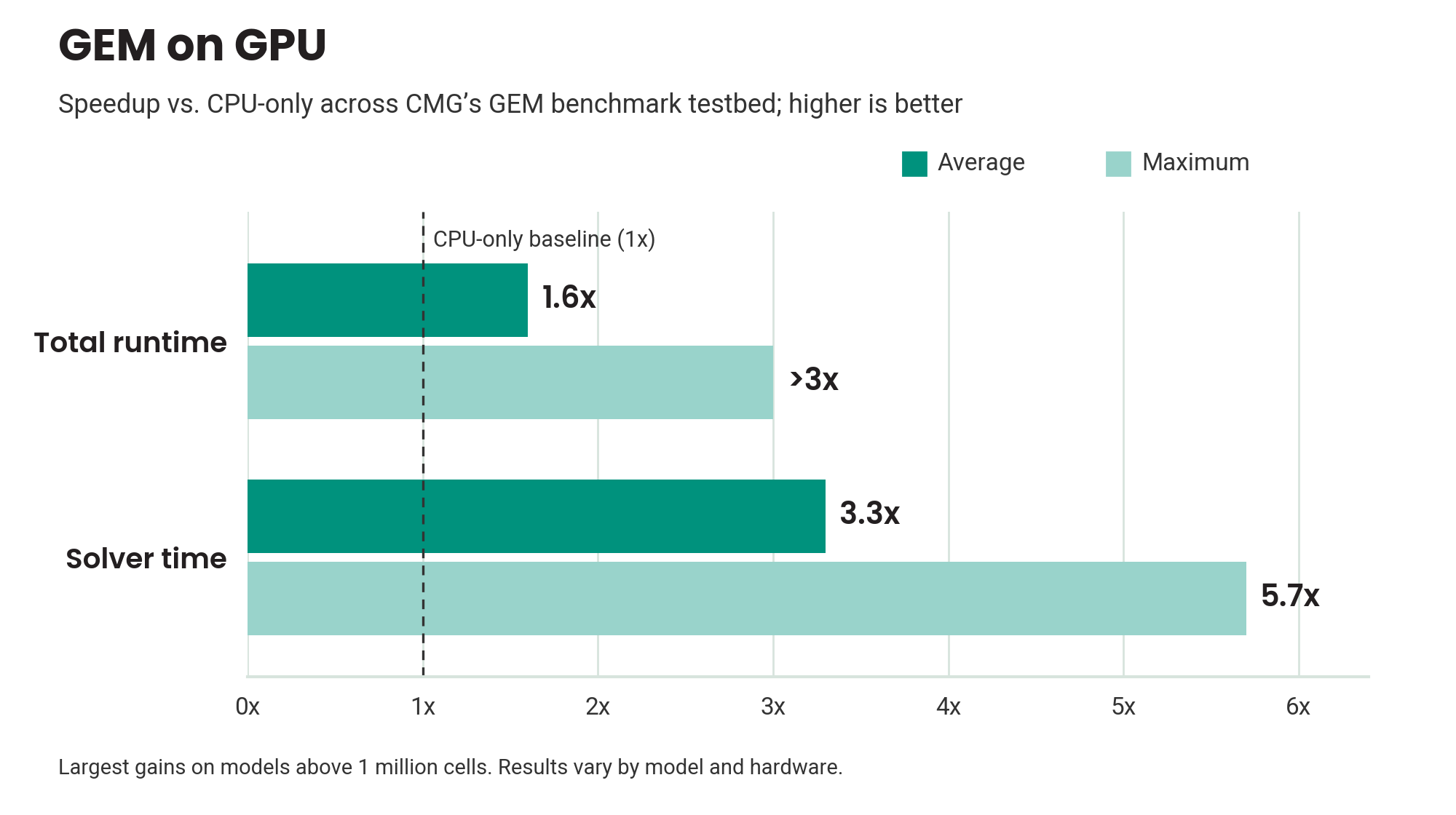
GEM on GPU vs. CPU-only across CMG’s internal GEM benchmark testbed. Total runtime covers the full simulation; solver time covers the solver alone.
For users the message is straightforward: the same trusted physics, the same input data, and dramatically less time waiting. Overnight studies become same-morning studies, and rigorous uncertainty analysis becomes practical for day-to-day operational decisions rather than only long-range plans.
04. T H E R O A D A H E A D
What does multi-GPU change?
Every GPU comes with a fixed amount of on-board memory. As customers build larger, more detailed, and more complex models, especially for compositional, unconventional, and carbon-storage studies, the biggest jobs simply outgrow a single card. Multi-GPU computing removes that ceiling.
The idea is intuitive. Instead of asking one GPU to carry an entire model, the reservoir is divided into regions and each region is assigned to its own GPU. The chips work simultaneously and exchange only what they need over fast interconnects, so the whole team behaves like one much larger processor.
Development is well underway. Early builds are already running large models that were previously out of reach on a single GPU, while delivering additional speedups from the extra compute. Multi-GPU support for GEM is scheduled for commercial release in January 2027. Beyond that, we will keep extending GPU acceleration across the CMG simulator family and into more of the work each simulation performs.
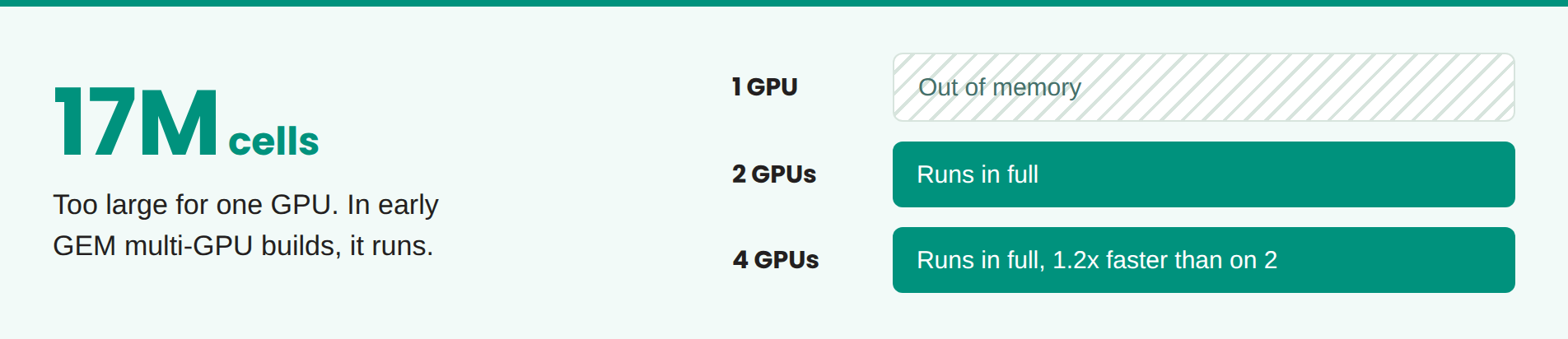
Early test results from a pre-release GEM multi-GPU build, CMG internal benchmarking on a 17-million-cell model. Performance will change as development continues toward the January 2027 release.
What is on CMG’s GPU roadmap?
CMG’s GPU work has moved from a first experiment on a gaming card to commercial releases, and is now extending across the simulator family. The key milestones are:
2025: IMEX on GPU. Commercial release of GPU-accelerated IMEX, including support for ARM processors and NVIDIA Grace Hopper superchips.
September 2026: GEM on GPU. GPU acceleration extends to GEM for compositional and unconventional studies.
January 2027: GEM multi-GPU (planned). Commercial release of multi-GPU support for GEM, for models too large for a single GPU.
First half of 2027: IMEX multi-GPU (planned). Multi-GPU support extends to the IMEX black-oil simulator.
Second half of 2027: STARS on GPU (planned). GPU acceleration arrives in STARS, CMG’s thermal and advanced-processes simulator.
| Simulator |
GPU |
Operating system |
GPUs per run |
Multi-GPU |
IMEX
Black oil |
Available
since 2025 |
Linux |
One |
Planned, first half of 2027 |
GEM
Compositional and unconventional |
Available
since September 2026 |
Linux |
One |
Planned, January 2027 |
STARS
Thermal and advanced processes |
Planned
second half of 2027 |
Linux |
One |
Planned, second half of 2027 |
Future planned dates are targets and may change. Published in November 2026.
05. O U R V I E W
The bottom line
From a single gaming card in an office to NVIDIA’s latest superchips, and soon to many GPUs working as one, our goal is unchanged: give engineers and decision-makers faster, more confident answers about the subsurface, at whatever scale their questions demand.